


I still remember sitting at a kitchen table cluttered with cereal crumbs and half-finished homework while a stack of Pokémon cards leaned against a glass of orange juice like tiny cardboard skyscrapers.
Back then, I never wondered about measurements, sizing, or technical specifications. I just knew those cards felt important, almost as if each one carried a pocket-sized universe.
Funny thing is, years later, collectors, players, and even parents often ask a surprisingly practical question: what are the dimensions of a Pokémon card?
The answer seems simple on the surface, yet it opens a doorway into the fascinating world of the Pokémon Trading Card Game (Pokémon TCG). From standard cards and jumbo collectibles to storage solutions and authentication methods,
understanding pokemon card dimensions matters more than many people realize. A card that’s a fraction too large or slightly too thick can affect storage, grading, gameplay, and even counterfeit detection.
Whether you’re a longtime collector chasing a Holographic Charizard, a parent buying supplies for a child, or someone curious about the hobby,
this guide explores everything you need to know about the dimensions of a Pokémon card, along with plenty of facts that collectors quietly obsess over.
Dimensions of a Pokémon Card: Quick Reference Table
| Item | Dimensions |
|---|---|
| Standard Pokémon Card | 2.5 × 3.5 in (63.5 × 88.9 mm) |
| Card Thickness | 0.012 in (0.305 mm) |
| Card Weight | ~1.78 g |
| Jumbo Pokémon Card | 5 × 7 in (127 × 178 mm) |
| Mini/Promo Card | 2.64 × 3.58 in (67 × 91 mm) |
| Recommended Toploader | 2.75 × 3.75 in (70 × 95 mm) |
| Binder Pocket Size | 2.65 × 3.75 in (67 × 95 mm) |
| TCG Launch Year | 1996 |
What Are the Official Dimensions of a Pokémon Card?
The official Standard Pokémon card follows the same sizing standard used by many popular trading card games.
The official pokemon card dimensions are:
| Measurement | Size |
|---|---|
| Width | 2.5 Inches |
| Height | 3.5 Inches |
| Width in mm | 63 Millimeters (mm) |
| Height in mm | 88 Millimeters (mm) |
These official Pokémon card measurements have remained remarkably consistent throughout the history of the game. It’s kinda impressive really, because millions of cards have been produced across decades while maintaining nearly identical sizing standards.
When collectors search for what size is a pokemon card in inches, the answer is straightforward: 2.5 x 3.5 inches.
Likewise, if someone asks for pokemon card dimensions in mm, the answer is 63 mm x 88 mm.
This sizing standard allows cards to fit into sleeves, binders, deck boxes, grading cases, and tournament accessories manufactured around the world.
Pokémon Card Dimensions Complete Guide for Every Card Type
Not every Pokémon card follows the standard format. Some special releases break the rules in rather delightful ways.
Standard Pokémon Cards
The majority of cards used in gameplay belong to this category.
These include:
- Basic Pokémon
- Evolution Pokémon
- Pokémon Energy Cards
- Special Energy
- Trainer Cards
- Item Cards
- Supporter Cards
- Stadium Cards
All of these use the same standard dimensions of 63 mm x 88 mm. It makes deck construction easier and keeps gameplay fair, which sounds boring until you realize how chaotic tournaments would become otherwise.
Promo Cards
Most Promo card releases maintain the same standard dimensions as regular cards.
Promotional cards often feature:
- Exclusive artwork
- Event branding
- Tournament rewards
- Limited distribution
Although artwork changes dramatically, the physical size usually remains unchanged.
Oversized Pokémon Cards
Collectors often encounter Oversized Pokémon card products.
These larger cards are not tournament legal and exist mainly as collectibles.
Common names include:
- Jumbo Pokémon card
- Giant Pokémon card
- Large Pokémon cards
The exact jumbo card dimensions have varied over different eras. Earlier versions were often around 5.75 x 8 inches, while newer releases frequently measure approximately 5.7 x 8 inches.
That means an oversized card can be more than twice the surface area of a standard card, which honestly makes displaying legendary Pokémon feel a bit more dramatic.
Pokémon Card Dimensions and Size Comparison With Other TCGs
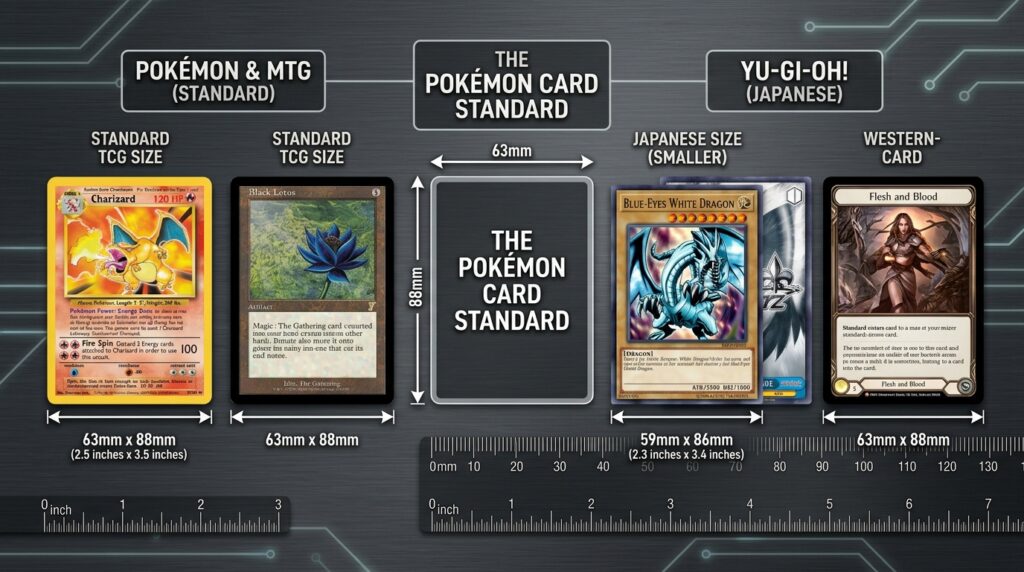
Many collectors participate in multiple card games.
Here’s a useful pokemon card size comparison.
| Game | Dimensions |
| Pokémon | 63 x 88 mm |
| Magic: The Gathering | 63 x 88 mm |
| Yu Gi Oh! | 59 x 86 mm |
| KeyForge | 63 x 88 mm |
The comparison creates some interesting observations.
A pokemon card vs magic card size comparison reveals they share identical dimensions. Because of this, sleeves and storage accessories often work for both games.
Meanwhile, a pokemon card vs yugioh card size comparison shows that Yu Gi Oh! cards are slightly narrower and shorter.
This tiny difference sounds insignificant, yet collectors notice it instantly when handling cards side by side. It’s weirdly obvious once you see it.
Pokémon Card Specifications Beyond Width and Height
Dimensions tell only part of the story.
Serious collectors also care about card thickness, weight, and material composition.
Card Thickness
The average pokemon card thickness is approximately:
- Around 0.30 mm
Thickness can vary slightly depending on:
- Printing era
- Manufacturing location
- Foil treatments
- Promotional releases
A card that’s noticeably thicker or thinner than expected may trigger further examination during counterfeit detection.
Card Weight
A standard Pokémon card generally weighs:
- Around 1.7 to 1.8 Grams (g)
This small detail becomes surprisingly useful during authentication.
Many experienced collectors use a pokemon card weight guide as one factor among many when evaluating questionable cards.
Weight alone doesn’t prove authenticity, but unusual deviations can raise red flags.
How Big Are Pokémon Cards Compared to Everyday Objects?
People often struggle to visualize measurements.
A standard Pokémon card is roughly:
- Similar in size to a credit card but slightly taller
- About the height of a smartphone screen section
- Comparable to many identification cards
- Small enough to fit comfortably in one hand
When people ask how big is a pokemon card, the easiest explanation is that it resembles a standard sports card or baseball card.
You can stack hundreds together, yet a single card still feels substantial enough to showcase detailed artwork and gameplay information.
Pokémon Card Sleeve Size Chart
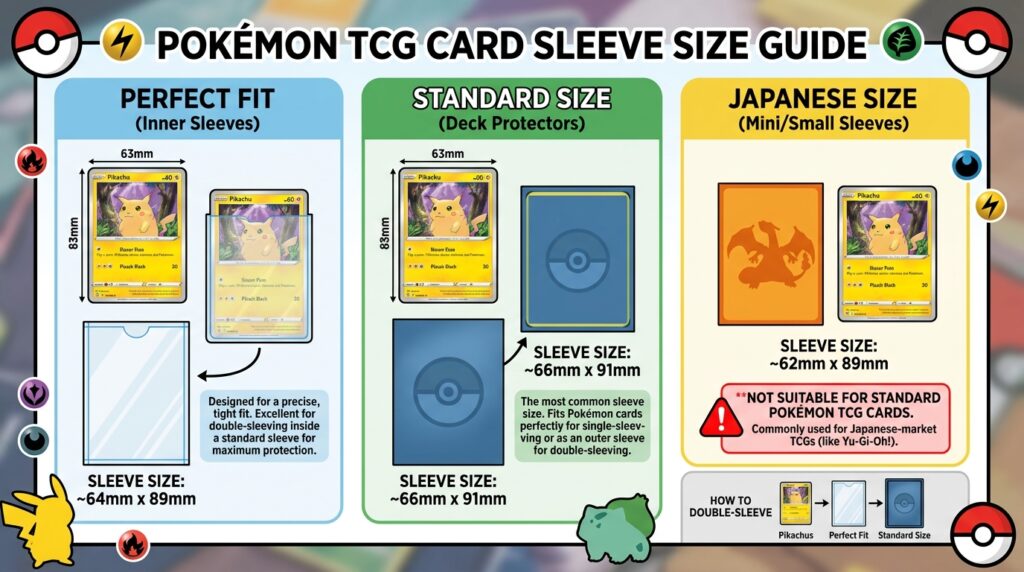
Understanding sleeve sizing protects cards from wear and tear.
The most common options include:
Penny Sleeves
Penny Sleeve products are inexpensive protective sleeves.
Typical dimensions:
- Approximately 66 x 91 mm
These are slightly larger than the card itself, allowing easy insertion.
Many are made from Polypropylene, a material commonly used in archival card storage.
Premium Sleeves
Premium Sleeve products offer:
- Better clarity
- Improved durability
- Enhanced grip
- Longer lifespan
Competitive players often choose premium sleeves for tournaments because they shuffle more smoothly.
Toploaders
A Toploader provides rigid protection.
Collectors frequently use them for:
- Rare pulls
- Vintage cards
- Shipping valuable cards
- Long term storage
A standard Pokémon card fits comfortably inside most regular trading card toploaders.
Pokémon Card Storage Guide
Protecting a collection isn’t just about preserving value. Sometimes it’s about preserving memories, and that feels a little more important honestly.
Binder Storage
A quality Binder remains one of the most popular storage solutions.
Look for:
- Acid free pages
- Side loading pockets
- Reinforced stitching
- Archival safe materials
Many collectors specifically search for pokemon card size for binder pockets, ensuring the pockets accommodate the standard 63 x 88 mm dimensions.
Deck Boxes
A Deck Box protects cards intended for gameplay.
Benefits include:
- Easy transportation
- Better organization
- Reduced corner damage
Competitive players often carry several deck boxes to tournaments.
Storage Boxes
A dedicated Storage Box or Cardstock Storage Box helps organize larger collections.
These are ideal for:
- Bulk cards
- Sorted sets
- Trade inventory
- Long term archiving
Playmats
A Playmat doesn’t store cards directly, but it reduces friction and surface damage during play.
For collectors who spend hours building decks, a playmat becomes surprisingly valuable.
Card Protection and Preservation Methods
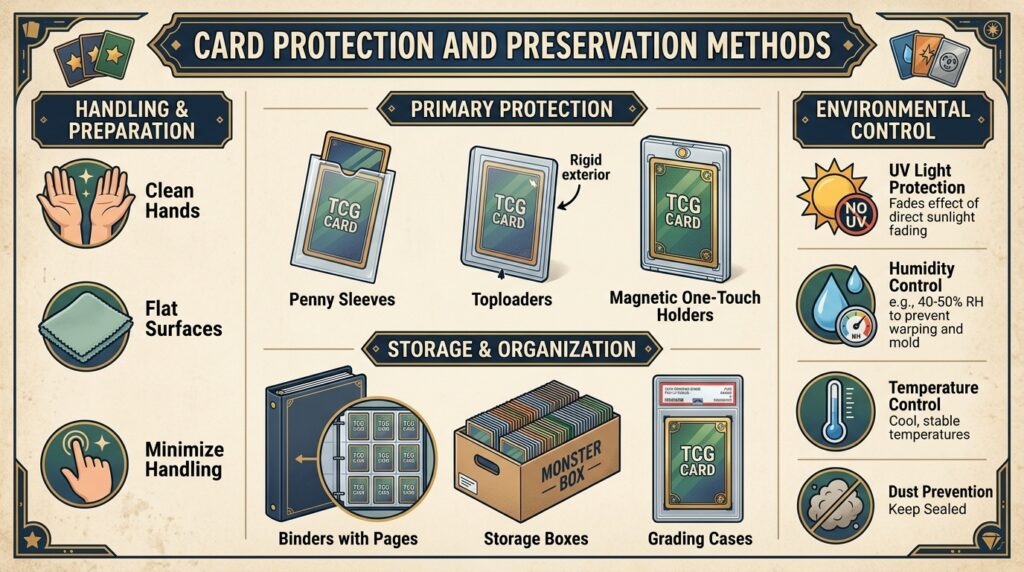
The enemies of trading cards are often invisible.
UV Damage
Sunlight can slowly fade card colors.
UV Protection products help reduce this risk.
Collectors displaying expensive cards often use UV-resistant cases to protect artwork from gradual discoloration.
Humidity Protection
Excess moisture can warp cards.
Humidity Protection strategies include:
- Climate controlled storage
- Silica gel packets
- Sealed containers
Even a slightly warped card can lose value, which feels unfair but that’s the reality of the market.
Scratch Protection
Surface scratches can dramatically affect grading outcomes.
Using sleeves and toploaders provides effective Scratch Protection while maintaining visibility.
Card Preservation
Successful Card Preservation combines:
- Stable temperature
- Low humidity
- UV protection
- Protective sleeves
Think of it as creating a tiny museum for cardboard treasures.
Authentic Pokémon Card Identification
The popularity of Pokémon has unfortunately created a market for fakes.
Authentic Pokémon Card Characteristics
An Authentic Pokémon Card typically features:
- Consistent card thickness
- Accurate weight
- High quality printing
- Proper cardstock layering
- Correct dimensions
Counterfeit Detection Tips
When evaluating possible Fake Pokémon Cards, examine:
- Color quality
- Font consistency
- Card edges
- Weight
- Thickness
- Light transmission
Many counterfeit cards fail basic card thickness check tests or use inferior materials instead of the Official Cardstock used in genuine production.
Collectors should compare suspicious cards against known authentic examples whenever possible.
Pokémon Card Collecting and Market Value
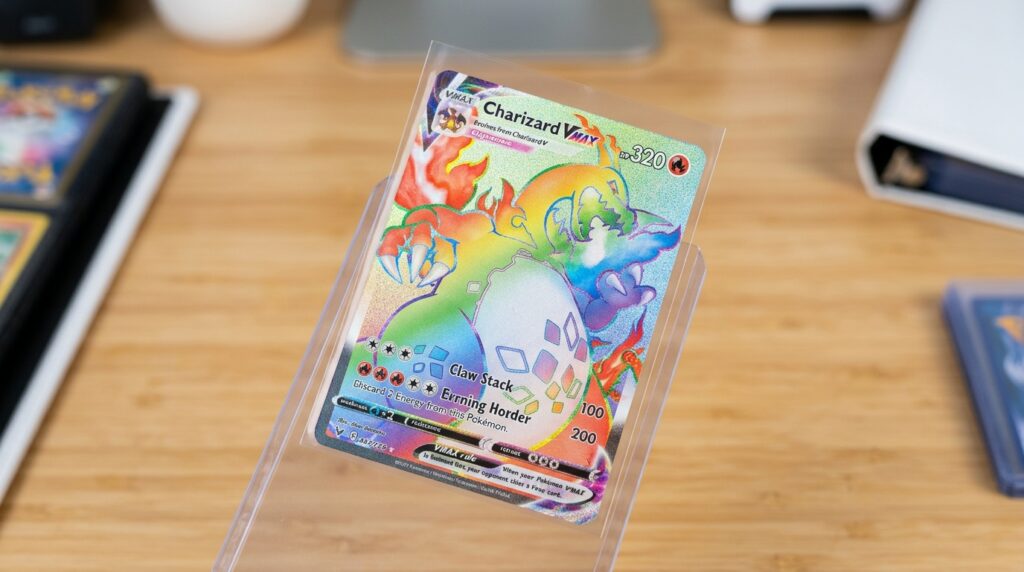
The world of Card collecting has evolved dramatically.
What began as a children’s game has transformed into a global hobby involving:
- Professional grading
- High profile auctions
- Investment discussions
- Community events
Rare Pokémon Cards
Examples of famous collectibles include:
- Base Set Charizard
- Holographic Charizard
- Tournament promos
- Trophy cards
These cards often represent the pinnacle of Rare card collecting.
Auctions and Trading
Major Auctions regularly feature high end Pokémon cards.
Factors influencing Card Value include:
- Rarity
- Condition
- Popularity
- Historical significance
- Demand
Mint Condition Matters
A card in Mint Condition can command dramatically higher prices than a worn example.
Tiny imperfections that most people would never notice can impact grading outcomes, which still amazes many newcomers.
Pokémon TCG Gameplay and Why Card Size Matters
The Trading Card Game (TCG) relies on standardized dimensions for fair play.
Every deck contains combinations of:
- Basic Pokémon
- Evolution Pokémon
- Trainer Cards
- Supporter Cards
- Stadium Cards
- Energy Cards
Consistent sizing supports:
- Smooth shuffling
- Tournament legality
- Fair gameplay
- Organized storage
During Competitive Play, even slight variations in card dimensions could potentially create identifiable cards within a deck, which is why standardization remains so important.
Deck Building Considerations
Successful Deck building involves balancing multiple card types.
Players constantly evaluate:
- Card mechanics
- Resource management
- Matchups
- Strategy
The physical dimensions may seem unrelated to gameplay strategy, yet uniform sizing makes every aspect of TCG gameplay function correctly.
The Emotional Side of Pokémon Card Collecting
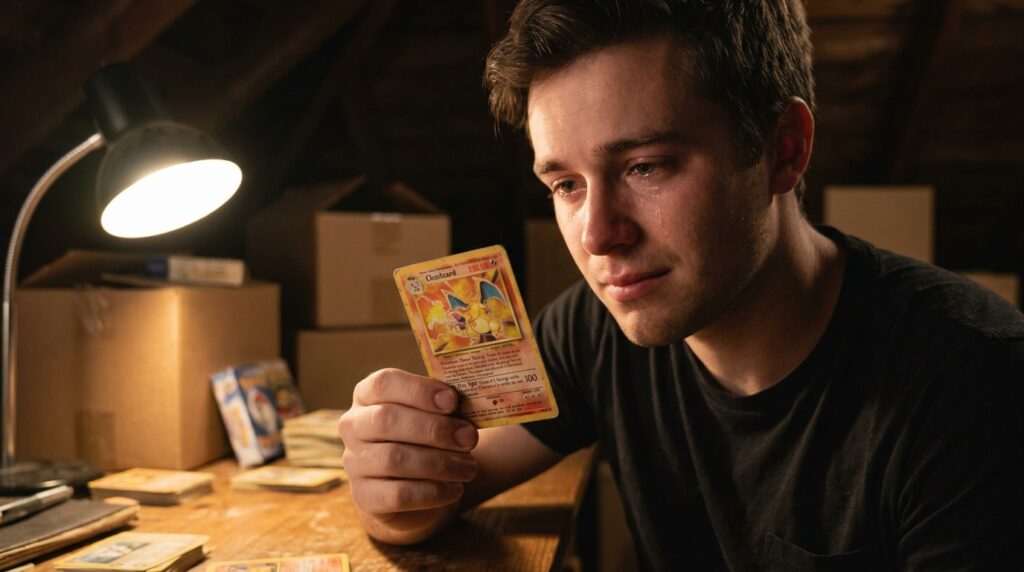
Not every measurement can be captured with a ruler.
For many people, Pokémon cards represent Nostalgia, Childhood memories, and Family bonding.
A parent teaching a child how to sort cards. A sibling trading duplicates on a rainy afternoon. Friends gathering at local TCG meetups after school. These moments quietly become part of a collection’s story.
One longtime collector once described it beautifully:
“The cards matter, but the people attached to the cards matter more.”
That sentiment echoes throughout the broader Pokémon community.
Collectors share stories, attend Card tournaments, participate in Schoolyard trading, and celebrate a hobby that spans generations. The cards become little cardboard time machines, carrying pieces of a personal Cultural legacy from one era to another.
Booster Packs, ETBs, and Collection Products
Modern collecting revolves around several product categories.
Booster Packs
A Booster Pack contains randomized cards and remains the classic collecting experience.
Opening one still feels a bit like opening a tiny mystery wrapped in foil.
Elite Trainer Boxes
The Elite Trainer Box (ETB) offers:
- Booster packs
- Sleeves
- Dice
- Accessories
- Storage components
Many newcomers begin their collecting journey with ETBs.
Special Collection Boxes
A Special Collection Box typically includes:
- Promo cards
- Booster packs
- Display items
- Sometimes jumbo cards
These products appeal to both players and collectors.
Frequently Asked Questions
pokemon card art dimensions
The artwork area on a standard Pokémon card is smaller than the full card size and varies slightly by card design. Most modern Pokémon cards feature art that fits within a framed image box while maintaining the standard card dimensions of 63 mm × 88 mm (2.5 × 3.5 inches).
Read this Blog:https://hynoval.com/how-big-is-1-5-inches/
Conclusion
Understanding the dimensions of a Pokémon card involves much more than knowing a pair of numbers. The official size of 63 mm x 88 mm forms the foundation of the entire Pokémon Trading Card Game, influencing storage, gameplay, grading, protection, and authentication.
Whether you’re researching pokemon card measurements, comparing trading card dimensions, searching for the right sleeves, evaluating authenticity, or simply expanding your knowledge as a collector, these specifications provide an essential starting point.
Yet perhaps the most interesting fact isn’t the width, height, thickness, or weight. It’s that millions of people around the world continue finding joy in these small rectangles of cardstock. Some chase rare cards, others build tournament decks,
and many simply hold onto memories that feel too valuable to measure.
So the next time you pick up a Pokémon card, take a moment to appreciate both its precise dimensions and the unexpectedly large stories it carries.
And if you have a favorite card, a memorable pull, or a collecting story of your own, share it with fellow fans. The measurements may be standardized, but every collection tells a completely different tale.