

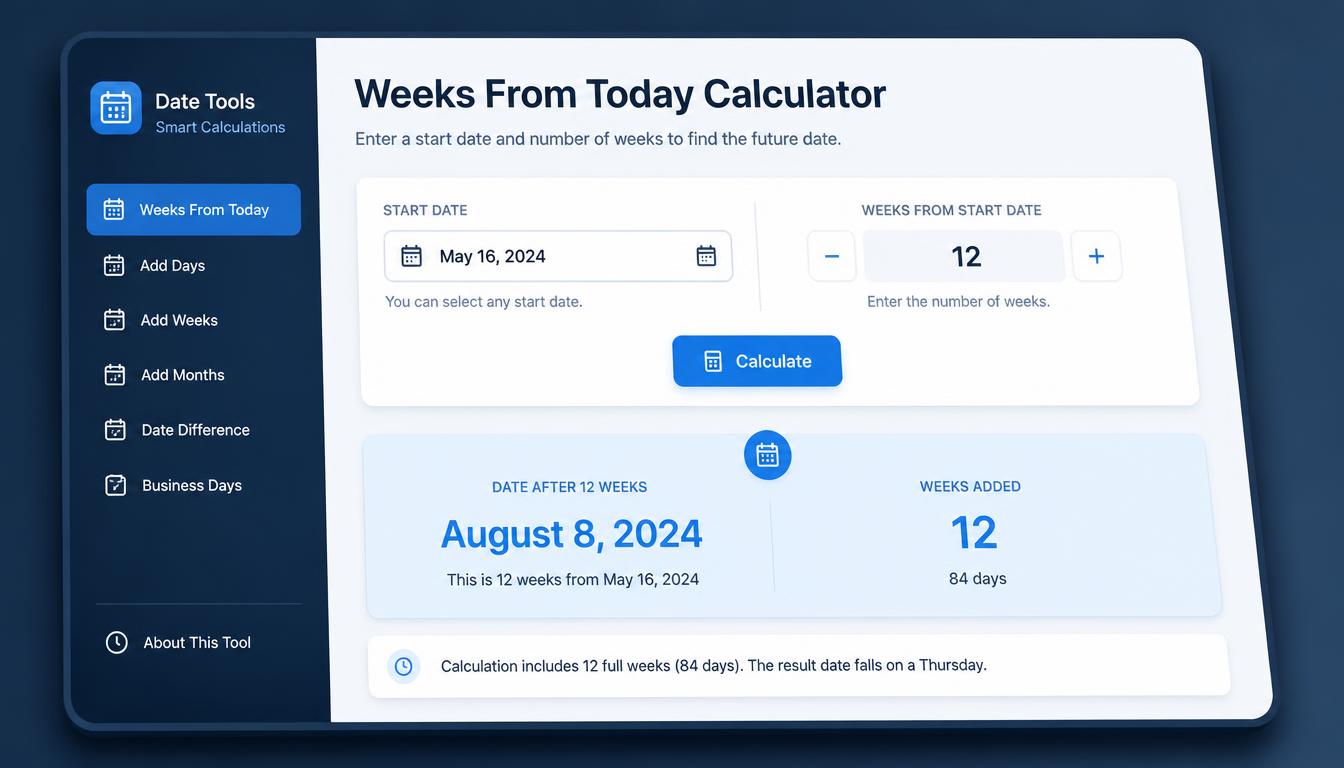
There is something slightly magical about looking at a calendar and wondering where a particular date will land weeks from now.
Maybe you are counting down to a baby girl’s arrival, planning a family celebration, marking a work deadline, or simply trying to figure out when a personal goal should be reached. A date can look ordinary on a screen, but sometimes it quietly carries a whole little story with it.
That is where a Weeks From Today Calculator becomes surprisingly useful.
Instead of counting tiny boxes on a calendar and wondering whether you accidentally skipped a Wednesday somewhere, you can quickly determine a future date by entering a number of weeks.
It sounds simple because, honestly, it is simple but the usefulness stretches into many parts of everyday life.
A good date calculator helps answer questions such as “What date is 8 weeks from today?” or “What will the calendar say 52 weeks from now?” It turns a vague idea of “several weeks later” into an actual day you can circle, save, plan around, or even look forward to.
| Weeks From Today | Days |
|---|---|
| 1 week | 7 days |
| 2 weeks | 14 days |
| 4 weeks | 28 days |
| 8 weeks | 56 days |
| 10 weeks | 70 days |
| 12 weeks | 84 days |
What Is a Weeks From Today Calculator?
A weeks calculator is a small but handy date tool designed to calculate a future date by moving forward a specified number of complete weeks from today or another start date.
Since a week contains 7 days, the basic calculation is wonderfully uncomplicated: take the number of weeks, multiply it by 7, and add those days to the starting date.
For example, 8 weeks means 56 days. So, if you want to find the date 8 weeks from today, the calculator moves the starting date forward by 56 days. Nothing mysterious is happening behind the curtain, though it may feel a bit magical when the answer appears instantly.
The same approach works for 52 weeks. Because 52 weeks equals 364 days, 52 weeks from today is 364 days after today’s date. Notice that it is not technically a full calendar year in every situation, which is one of those tiny calendar details that catches people off guard sometimes.
A future date calculator is especially useful when the starting point is known but the ending point is not. Instead of asking, “When is sometime in the future?” you can specify the number of weeks, perform the date calculation, and get a definite answer.
How to Calculate Weeks From Today Manually
You don’t always need a digital calculator. A piece of paper, a calendar, and a little patience can do the job too, although the manual method gets slightly annoying when you’re dealing with a larger number of weeks.
Start with today as your start date. Then convert the specified number of weeks into days by using 7 days per week. If the request is for four weeks, that is 28 days. If it is 8 weeks, that’s 56 days. If somebody gives you 15 weeks, you are working with 105 days.
The important part is to add those days forward from the starting date rather than simply guessing where the month might end.
Month lengths aren’t friendly enough to keep things uniform; some have 30 days, some 31, and February decides to be different depending on the year. Calendar arithmetic can be a little cheeky like that.
For example, suppose your start date is March 10 and you want to add 8 weeks to a date. First, convert eight weeks into 56 days. Then count or calculate 56 days forward. The resulting date is your future date.
A calculator performs this date arithmetic almost instantly, which is why it is much more convenient when you are calculating many dates or working with longer periods.
Why Counting Weeks Can Be More Useful Than Counting Days
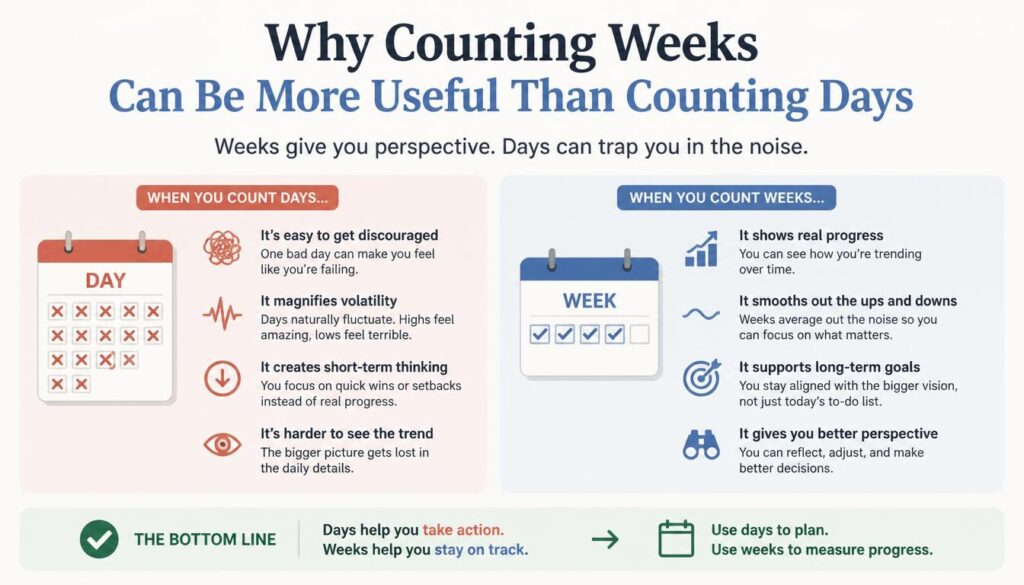
Days are precise, but weeks often make planning feel more natural. People commonly think in weekly rhythms: two weeks until vacation, six weeks until a project ends, eight weeks until a celebration, or twelve weeks until a personal milestone.
For parents, this can be particularly familiar. Pregnancy planning, newborn appointments, family visits, baby celebrations, and photographs can all involve periods measured in weeks.
A grandmother might say, “We’ll visit when she’s about eight weeks old,” while another family member immediately asks, “And what date is that exactly?” That’s the moment when a weeks from now calculator earns its little place in the toolbox.
Weeks are also useful for goals. A person might decide to spend 12 weeks learning a skill, exercising consistently, preparing for an examination, or organizing a major event.
Rather than repeatedly asking how much time remains, they can establish a specified date at the beginning and know when the period finishes.
This is really the difference between time that feels fuzzy and time that can be planned.
Weeks From Today Calculator for Planning Special Dates
A Weeks From Today Calculator isn’t only for office deadlines and practical chores. It can help with meaningful personal moments too.
Imagine a family has just welcomed a baby girl. Everyone is sending baby girl congratulations, sharing photographs, and making promises to visit soon.
Someone wants to arrange a small family gathering eight weeks later, but nobody wants to spend ten minutes arguing over which date “eight weeks from now” actually means.
The calculator settles it.
That date can then become the date for a naming celebration, family lunch, newborn photo session, visit from relatives, or another special occasion. The calculation itself is ordinary, but the event waiting at the other end of it certainly isn’t.
Different families and cultures mark the arrival of a daughter in different ways. Some families gather relatives for a meal, some offer prayers or blessings, and others keep the occasion beautifully quiet with only close family around. There isn’t one universal way to celebrate a newborn girl, and that variety is part of what makes these moments so lovely.
A simple date tool can therefore sit behind some very human plans: a cake, a handwritten card, a family photograph, or perhaps a message that says, “Eight weeks already look how much she’s changed.”
What Date Is 8 Weeks From Today?
One of the most common questions people ask is what date is 8 weeks from today. The calculation is straightforward because eight weeks equals 56 days.
To calculate 8 weeks from a start date, simply move forward 56 days. If you are using a calculator, enter the starting date and specify eight weeks. The result is the future calendar date.
The phrase eight weeks from a date is interchangeable with “56 days after that date,” provided you are measuring whole weeks in the usual seven day sense.
This can be helpful when comparing different planning methods, because someone may describe a deadline in weeks while another person thinks in days.
It is worth remembering that the exact answer depends entirely on the starting date. Change the start date, and naturally you change the resulting date too. Time has that mildly inconvenient habit of obeying mathematics.
What Date Is 52 Weeks From Today?
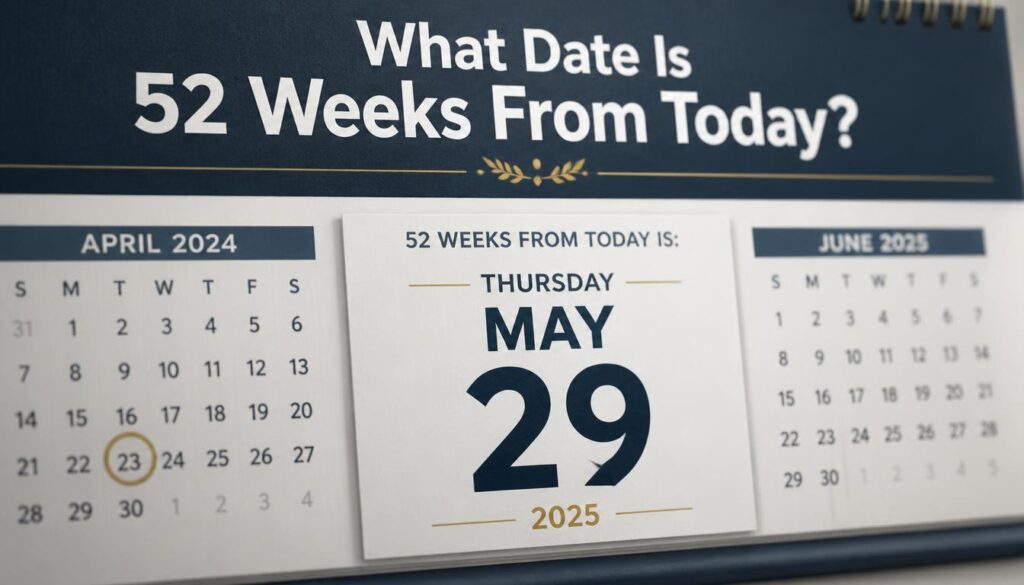
Another useful example is what date is 52 weeks from today. Since one week contains seven days, 52 weeks equals 364 days.
That means a 52 weeks from today calculation takes the current date and moves it ahead by 364 days. This is close to one year, but it isn’t always the same as adding one calendar year.
Why the distinction? Calendar years can contain 365 or 366 days, depending on whether a leap year is involved. So, 52 weeks from today and “one year from today” can occasionally produce different dates.
For ordinary planning, that difference might not matter much. For contracts, formal deadlines, recurring schedules, or detailed project plans, it can matter quite a lot. When precision is important, use the actual date calculation rather than relying on the phrase “about a year.”
Using a Calendar to Calculate a Future Date
A traditional calendar remains one of the nicest ways to understand how date calculations work. There is something satisfying about physically moving forward through the pages or boxes, even if it takes a little longer.
If you need to count weeks on calendar pages, remember that moving forward exactly one week means moving forward seven days. You can therefore jump from the same weekday to the same weekday each time. Monday to the following Monday is one week, for example.
This method becomes particularly handy when you need to visualize month transition. A date near the end of a month can make mental calculation confusing, especially when the next month has a different number of days.
Suppose a deadline falls near the final days of April and you need to determine the date several weeks later. Instead of assuming that every month behaves alike, follow the actual calendar or use a calculator. Your future self will probably thank you for avoiding a small administrative headache.
Adding Weeks to a Date in Microsoft Excel
For people who regularly work with dates, Microsoft Excel can act as a surprisingly capable date calculator. Since Excel stores dates in a numerical format, you can perform date arithmetic by adding the appropriate number of days.
Imagine cell A1 contains your start date and cell B1 is where you want the calculated future date to appear. If you want to add eight weeks, you can use a formula equivalent to:
=A1 + (8 × 7)
The multiplication by 7 converts the eight weeks into 56 days. Excel then adds those days to the date stored in cell A1.
For a variable number of weeks, you can make the spreadsheet more flexible. If A1 contains the starting date and B1 contains the number of weeks, a formula such as:
=A1 + (B1 * 7)
allows you to replace the number of weeks without rewriting the entire formula. That’s a small improvement, but in a busy spreadsheet it can save a surprising amount of fiddling around.
This is a simple example of an Excel date formula, and it demonstrates how spreadsheet software can turn repetitive date work into something almost automatic.
Adding Weeks to a Date in Google Sheets
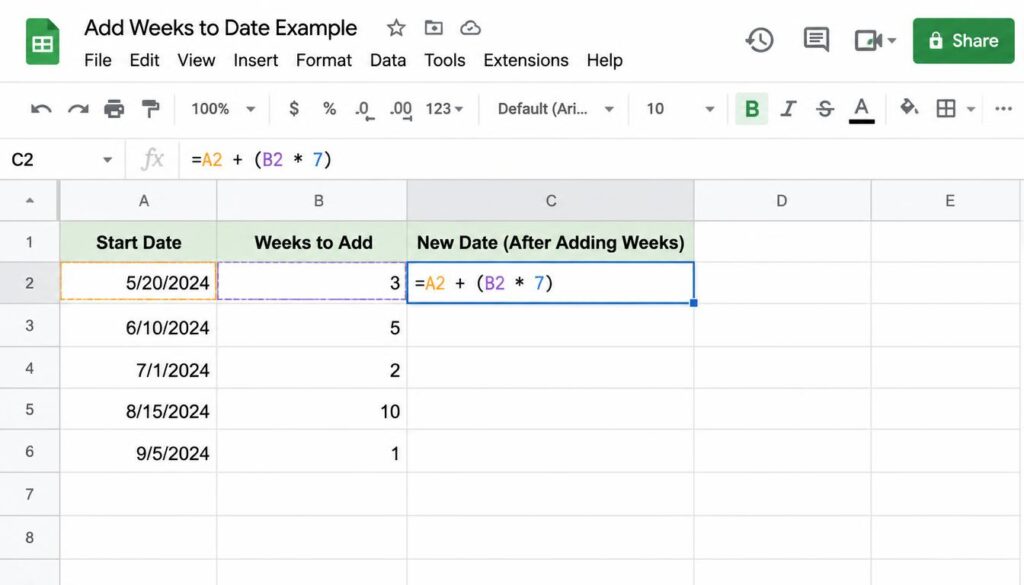
Google Sheets handles this type of spreadsheet date calculation in a very similar way. If a start date cell contains a valid date, you can add the number of days represented by your chosen weeks.
For instance, if A1 contains the starting date and B1 contains the specified number of weeks, the formula can be:
=A1 + (B1 * 7)
The result appears as a date as long as the destination cell is formatted appropriately. If it suddenly displays a mysterious number instead, don’t panic the spreadsheet is generally showing its internal date value rather than the friendly calendar format you’re expecting.
This makes Google Sheets add weeks to a date particularly useful for collaborative planning.
A family could maintain an event schedule, a small business could track deadlines, or a project team could calculate future milestones without everyone performing the same calculation separately.
The beauty of a spreadsheet is that you can substitute the value in B1 and instantly get another result. One cell becomes your starting point, another becomes your specified number of weeks, and the formula handles the rest.
Common Reasons People Calculate Weeks Into the Future
There are dozens of reasons someone might want to calculate future dates, and many of them are more ordinary than people expect.
- Planning events: A family may choose a date several weeks after an important occasion so everyone has enough preparation time, which sounds sensible until everyone starts suggesting different Saturdays.
- Setting personal goals: A twelve week goal can have a definite finishing date, making an abstract target feel much more real and reachable.
- Finding deadlines: Businesses, students, freelancers, and project teams can use a specified number of weeks to determine when a task period ends.
- Planning appointments: Some appointments or follow ups are described in weekly intervals, so a date calculator can turn “come back in six weeks” into an actual date.
- Organizing travel: You can determine a future date before checking flights, accommodation, or family availability, which saves a little calendar chaos later.
- Tracking baby milestones: Parents may want to know the calendar date corresponding to a certain number of weeks after birth, especially when planning visits or family gatherings.
- Managing recurring projects: A weekly schedule can be projected forward by several weeks without manually counting each calendar square.
- Preparing celebrations: Birthdays, anniversaries, family dinners, and other gatherings often need advance planning, and knowing the exact date gives everybody something concrete to work with.
Handling Month Boundaries Without Getting Confused
One of the biggest reasons people prefer a calendar date calculator is that month boundaries can make manual calculations surprisingly messy.
If you begin near the end of a month, adding 14 days may carry you into the next month. Adding 35 or 42 days can cross two months. The number of days in those months matters, and February is once again waiting nearby with its unusual little rulebook.
A reliable approach is to think in terms of actual days rather than assuming each month contains four weeks. Four weeks is 28 days, which is shorter than most calendar months. This is why “one month later” and “four weeks later” should not automatically be treated as identical.
When you add weeks to a date, you are performing fixed seven-day intervals. When you add a calendar month, you are following a different rule. Keeping those two ideas separate prevents a whole collection of tiny date mistakes.
Weeks From Now Versus a Specific Date

There is an important difference between asking “How many weeks from now?” and asking “How many weeks are there between these two dates?”
The first is a future date calculation. You know the starting point usually today and want to move forward a specified number of weeks.
The second is closer to a date difference calculation. You already have two dates and want to determine how far apart they are.
For example, “Find the date six weeks from today” requires counting forward. But “How many weeks are there between June 1 and July 13?” requires comparing two existing dates.
Both calculations are useful, but they answer different questions. A weeks calculator may support one or both depending on its design, so it’s worth checking what kind of calculation the tool is actually performing before trusting the result.
A Simple Spreadsheet Setup for Repeated Calculations
If you frequently need to calculate dates, setting up a small spreadsheet can be more convenient than using a calculator repeatedly.
You could create three columns: one for the start date, one for the number of weeks, and one for the resulting future date. In Microsoft Excel or Google Sheets, the date formula can then use the first two cells to automatically produce the third.
For example:
Start Date | Weeks | Future Date
[date] | [number] | =StartDate + (Weeks * 7)
Once the structure is ready, you can enter different values without changing the underlying formula. It becomes a little personal future date calculator living inside your spreadsheet.
For larger planning tasks, this approach is much less time-consuming than repeated manual calculation. It is especially useful when several people need to see the same schedule and make changes to it.
How to Make Date Calculations More Personal
Numbers tell you when something happens, but they don’t tell you why it matters. That’s where the human side of planning comes in.
If you’re calculating a date connected with a newborn baby girl, don’t stop at the result. Write the date somewhere meaningful and attach a small note. “Eight weeks since she arrived,” for example, may become a family photograph, a handwritten memory, or a quiet Sunday lunch.
A newborn doesn’t care what a date calculator says, of course. But the people who love her might care very deeply about that date years later.
A father might remember the first week as a blur of coffee and tiny socks. A grandmother may remember holding her granddaughter for the first time and being afraid to move because she looked so peaceful.
A sibling may simply remember that the baby made funny noises and somehow became the center of the entire house overnight.
That is why future dates are more than numbers. Sometimes they are little doors into memories that haven’t happened yet.
Creative Ways to Use a Future Date
Once you’ve calculated a future date, there are plenty of ways to make the information useful instead of letting it disappear into a notes app.
- Put the date on a family calendar and give it a short title that means something to you.
- Create a countdown for an important event, because anticipation is part of the fun and not merely waiting around.
- Add a reminder to your phone so the date doesn’t vanish beneath tomorrow’s grocery list.
- If you’re planning a baby celebration, send the date alongside a warm personal message rather than a plain announcement.
- Use a spreadsheet when multiple future dates need to be tracked together, especially for recurring milestones.
- Write a short letter to your future self about what you hope will have happened by that date.
- Take a photograph on the calculated date and compare it with the starting-day photograph later.
- For long-term goals, divide the period into weekly milestones so the distant finish line doesn’t feel like a mountain sitting miles away.
Frquently Asked Questions
weeks from today
A week from today means the same day of the week, seven days from the current date.
8 10 weeks from today
8 10 weeks from today means a date between 56 and 70 days from the current date.
week from today
A week from today is exactly seven days after today, falling on the same weekday.
what is 10 weeks from today
10 weeks from today is 70 days after today. It falls on the same day of the week as today.
a week from today
A week from today means seven days from the current date, on the same weekday.
Read This Blog:https://hynoval.com/hours-from/
Final Thoughts on Weeks From Today Calculator
A Weeks From Today Calculator may seem like one of those tiny online utilities that exists only to save you from counting calendar squares. In reality, it does something a bit more useful: it translates an idea about time into a definite date.
Whether you’re trying to calculate weeks from today, determine a date several weeks from today, plan a deadline, organize a celebration, or calculate a future milestone, the basic principle stays wonderfully simple.
Convert weeks into days, remember the 7 days in each week, and move forward from the correct start date.
For occasional calculations, a calculator is the easiest route. For repeated planning, Microsoft Excel and Google Sheets can handle the job with a simple spreadsheet formula and cell references.
And for quick visual checking, the humble calendar still works perfectly well, provided you don’t lose your place halfway through the month.
But perhaps the nicest thing about looking ahead is that the calculated date represents something waiting for you. Maybe it is a deadline you’ll finally finish, a trip you’ve been dreaming about, a family gathering, or another chapter in the life of a newly welcomed daughter.
A date in the future is only ink, pixels, or numbers until somebody gives it meaning.
So calculate it, mark it down, and then let life happen between today and that little square on the calendar.
And if you have a favorite way of counting weeks, planning milestones, or celebrating a baby girl’s arrival, share your experience with others sometimes the best calendar advice comes from somebody who has already made the mistake of counting the same month three times.