

There is a peculiar moment when you realize the water in your own house has been leaving tiny signatures everywhere: a cloudy glass, a chalky faucet, a shower door that never quite looks clean, and laundry that comes out of the washer feeling a little too much like cardboard.
You scrub, rinse, buy another cleaner, and somehow the spots return as if they pay rent. That, very often, is the quiet fingerprint of hard water.
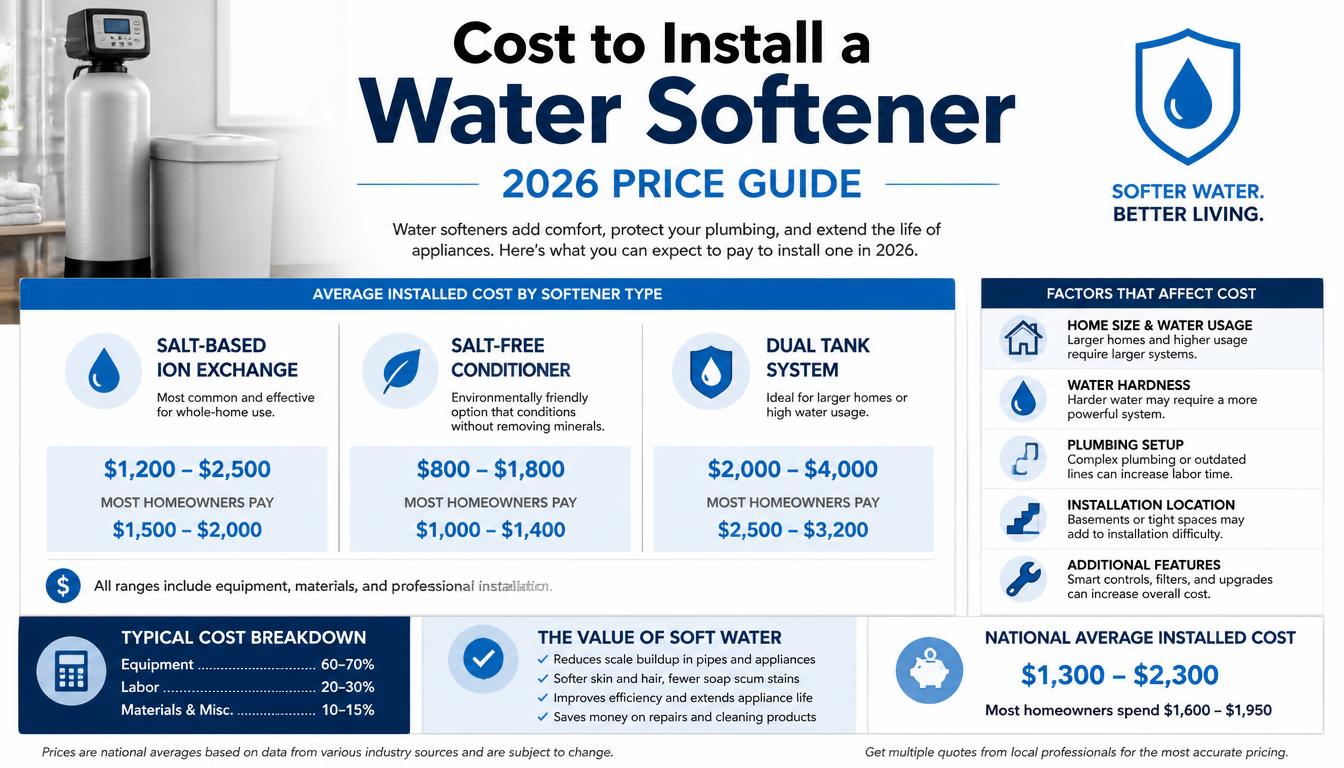
If you are now wondering about the cost to install a water softener, the short answer is not one neat little number.
In 2026, homeowners can expect a broad project range of roughly $500 $6,000, while the commonly reported national average is about $1,500 for the system and installation together.
Some unusually simple or specialized projects can fall outside that range, so your actual water softener installation cost depends heavily on the equipment, household size, water hardness, plumbing layout, and local labor rates. A Angi+1
And there is the funny part: the softener itself is only one character in this little plumbing drama. You may also be paying for testing, fittings, drainage, a permit, plumbing modifications, or repairs that nobody noticed until the plumber looked behind the wall.
A sensible budget therefore asks not merely, “What does the machine cost?” but, “What will it take to make the machine behave properly in my home?”
| Cost Item | Typical 2026 Price |
|---|---|
| Water softener system | $800 $2,500 |
| Professional installation | $500 $3,000 |
| Typical installed cost | $1,000 $3,000 |
| Basic salt based system | $800 $2,000 |
| Dual tank system | $1,500 $3,000+ |
| Salt free conditioner | $1,000 $2,500 |
| Extra plumbing/drain work | $150 $800+ |
| DIY installation | $50 $200 in parts |
2026 Water Softener Installation Cost at a Glance
The 2026 water softener prices below are useful planning figures rather than promises carved into a stone countertop, because contractor pricing varies by location and project complexity.
Current 2026 cost data places the average total installation around $1,500, with common project totals reaching from about $200 to $6,000 in broader market data. A Angi+1
- National average price: $1,500 for a typical installed system.
- Typical price range: $500 $6,000 as a practical homeowner budgeting range.
- Installation cost: $1,000+ is possible when plumbing is complicated, although basic labor can be substantially lower.
- DIY potential savings: around $1,000 in some projects, mainly by eliminating professional labor, though savings depend on what work is actually required.
- Permit cost: $20 $100 is a reasonable budgeting allowance where a permit is required, but local fees vary.
- Water test kit: $20 $50 for a basic homeowner test.
- Professional water testing: $50 $100 is a useful planning figure, though comprehensive laboratory testing can cost more.
- Salt refill: $5 $10 per 40 pound bag is a commonly reported range for sodium chloride softener salt. AAngi
- A conventional salt-based system often costs less than more elaborate dual-tank equipment.
- A dual tank water softener costs more because you are essentially buying continuous softening capability rather than a single resin tank.
- A reverse osmosis system is a different category of treatment altogether and can cost several thousand dollars when installed as a larger whole-home treatment system.
That last distinction matters. A water softener system is designed primarily to address hardness minerals, not every possible contaminant hiding in your water.
Calling every water treatment device a softener is a bit like calling every vehicle a truck because it has four wheels. It gets the conversation moving, but it doesn’t get the details right.
What Exactly Are You Paying For?
When people search how much does a water softener cost, they often imagine a tank with a price tag attached. The actual bill is more like a small family tree.
The equipment may include a resin tank, brine tank, control valve, bypass valve, drain line and connecting fittings. In an ion-exchange system, resin beads capture calcium and magnesium and exchange them for sodium or potassium ions.
During water softener regeneration, a brine solution restores the resin’s ability to remove hardness. The EPA’s 2026 guidance describes the typical softener as having a tall resin tank and a shorter brine container, although system designs vary. U US EPA
Then comes the installation itself. A plumber may need to cut existing pipes, connect the softener to the incoming water line, provide a drain route, install a bypass, and make sure the system can regenerate without turning your basement into an accidental indoor swimming pool.
Professional installation commonly falls somewhere around $150 to $1,000 for labor depending on the project, with more complicated work costing considerably more. A Angi+1
If your home has no convenient plumbing loop, the situation changes again. A softener may need additional plumbing modifications, new pipe runs, drainage work, or electrical access.
This is where a bargain looking installation can suddenly grow legs and walk toward the higher end of your estimate.
Water Softener Cost by System Type
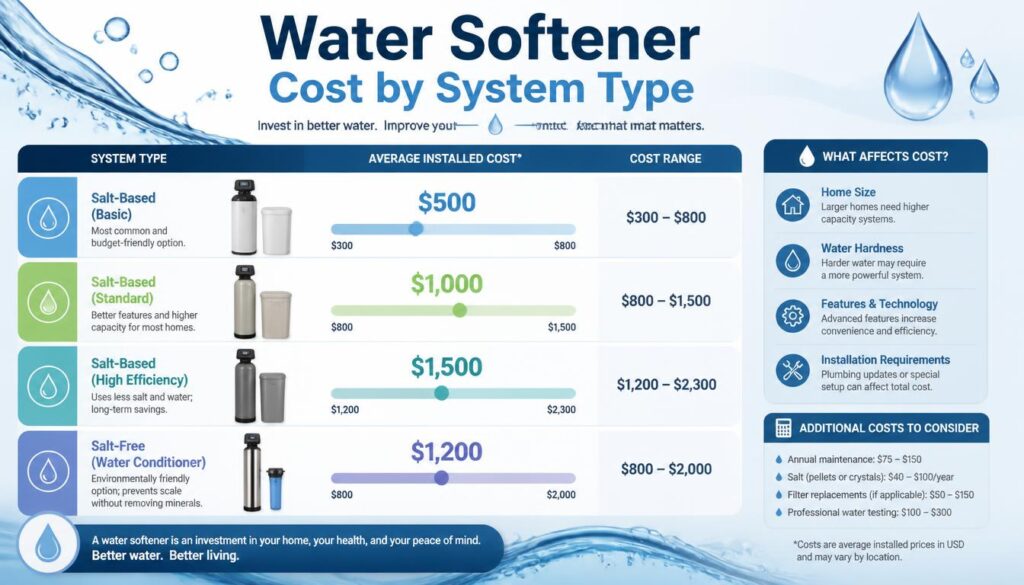
Not every softener works the same way, and pretending they do is a good way to buy the wrong machine with impressive confidence.
Salt Based Water Softener
A salt-based water softener, usually an sodium chloride water softener, is the classic ion-exchange design. It removes calcium and magnesium from the water and replaces them with sodium ions.
A reasonable equipment budget for a conventional salt-based system is around $400 $1,200, before considering installation and unusual plumbing work. The installed price can therefore land much higher, especially for larger homes or premium equipment.
Salt is relatively inexpensive. A 40 pound bag may cost around $5 $10, although actual prices depend on the retailer and region. A Angi
For many households, the ongoing water softener operating cost for salt may hover around $10 per month, give or take, but heavy water use and high water hardness can push consumption upward.
A five member household with very hard water is simply going to ask more from its system than one person living in a small apartment.
Potassium Chloride Water Softener
A potassium chloride water softener uses potassium chloride instead of sodium chloride during regeneration. It can be attractive for households concerned about sodium levels in softened water, although potassium pellets generally cost considerably more.
A practical planning figure is $25 $50 per bag for potassium refill material, while some current pricing can run even higher depending on bag size and supplier.
That means a potassium water softener can have an ongoing cost around $50 per month in a high-use household, though real consumption varies dramatically.
This isn’t automatically “better,” either. The right choice depends on your water, household needs, budget, and local conditions. Connecticut’s public-health guidance, for example, specifically discusses potassium chloride as a way to minimize sodium in treated water. C.gov
Dual-Tank Water Softener
A dual-tank water softener, sometimes called a two-tank system, has a clever trick: while one tank is regenerating, the other can continue treating water.
That makes a dual-tank softener appealing for a large family, busy multi-family home, or household where someone seems determined to take a 45-minute shower exactly when regeneration wants to happen.
A typical dual-tank system might cost $1,000 $2,200, while premium configurations can reach up to $5,000 before or depending on installation.
The higher price isn’t merely decorative. You are paying for greater capacity, redundancy and continuous operation.
Magnetic Water Softener
A magnetic water softener or magnetic conditioner is a very different proposition. These devices attach around a pipe and attempt to influence mineral behavior rather than removing calcium and magnesium through ion exchange.
Typical prices may fall around $250–$600, making them tempting when someone sees a large conventional softener bill and thinks, “Surely there is a tiny gadget for this.”
The important distinction is that a magnetic conditioner does not function like a conventional ion-exchange water softener.
If your primary problem is substantial water hardness and mineral removal, compare the technology carefully rather than assuming the cheapest device performs the same job.
Reverse Osmosis System
A reverse osmosis system uses pressure to push water through a tight membrane, removing a broad range of dissolved substances. It is often used at a drinking water tap rather than as a direct replacement for a whole-house softener.
A large reverse osmosis system or integrated treatment project can reach approximately $4,000–$11,000, depending on configuration and scope.
That is a very different investment from a standard softener, and it shouldn’t be selected merely because the phrase “better water” sounds attractive.
Why Hard Water Changes the Price
Hardness is mostly about calcium and magnesium, those quiet minerals that travel with groundwater and later become the crusty evidence on your fixtures.
The EPA notes that water hardness is commonly measured in grains per gallon (GPG), milligrams per liter, or parts per million.
Water above roughly 120 mg/L, or 7 GPG, is generally considered hard, while softening is often recommended when hardness exceeds about 180 mg/L, or 10 GPG. U US EPA
The harder the water, the more capacity your softener may need. A larger household also consumes more water. Put those together and you may need a higher grain capacity system, which costs more.
Imagine a five-member household using a great deal of water with hardness around 10 GPG.
A small 24,000 grain water softener may not be the sensible choice simply because it happens to be on sale. Proper water softener sizing considers household demand, water hardness and the desired regeneration frequency.
An undersized system can regenerate too often. An oversized one may cost more than necessary. Neither is the plumbing equivalent of winning the lottery.
Testing Water Before Buying Anything
Before you decide whether you need a whole-house water softener, test the water.
A basic water hardness test can help establish the GPG level. A homeowner water test kit might cost roughly $20 $50, while professional water testing can start around $50 $100, with broader laboratory panels costing more.
Testing becomes particularly important with private well water. A well may have hardness, iron, manganese, sulfur compounds or other water impurities that a basic softener isn’t designed to handle.
If you have municipal water, you can start by reviewing the supplier’s water-quality report and then test further if something seems off.
This is also where people sometimes confuse a softener with a water filtration system. A softener primarily addresses hardness. A filter may target sediment, chlorine, tastes, odors, VOCs or other contaminants, depending on its design.
In other words, don’t buy a softener to solve a chlorine problem and then wonder why the chlorine problem is still sitting there looking smug.
The Plumbing Problems That Can Inflate Your Bill
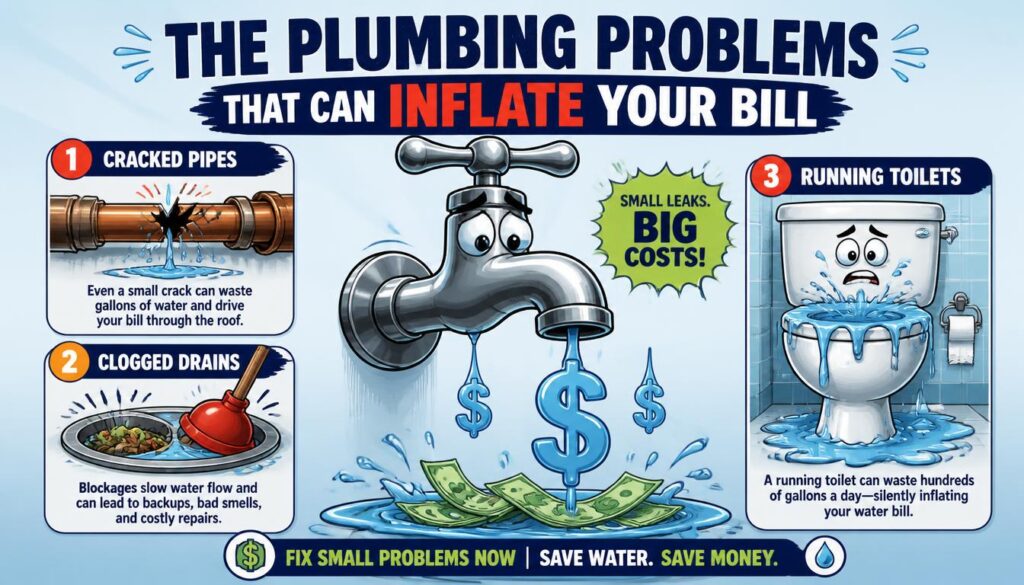
A straightforward water softener installation is one thing. Installing one in a home with decades of improvised plumbing is another species entirely.
Your contractor may discover:
- Old or corroded pipes.
- No suitable softener loop.
- Difficult access in a crawl space.
- An inconvenient drain location.
- Insufficient floor drainage.
- Low existing water pressure.
- Leaking connections.
- Damaged shutoff valves.
- Plumbing that doesn’t meet current requirements.
- Electrical limitations near the installation point.
- Existing plumbing issues that need repair first.
This is why a cheap online quote isn’t necessarily the cheapest final project. If the installer has to repair a pipe wall connection, reroute a drain, or make substantial plumbing modifications, the original number can become historical fiction rather quickly.
DIY Water Softener Installation vs. Hiring a Professional
A DIY water softener installation can save money if you already understand plumbing and have the appropriate tools.
Current installation guidance describes the project as challenging, and professional sources warn about the risks of improper connections, leaks and warranty problems. A Angi+1
If you install it yourself, you might save around $500 $1,000 in labor on a typical project, depending on what the contractor would have charged. But “saving labor” is only a saving if the work succeeds.
A professional installation usually involves testing the water, selecting or confirming the correct system, shutting down the supply, draining lines, connecting the equipment, setting up the brine and resin tanks, attaching the drain, starting the system and running a regeneration or backwash cycle. A Angi
For an experienced homeowner, a simple accessible installation may be manageable. For someone whose relationship with plumbing begins and ends with knowing where the faucet is, a licensed plumber is probably the less expensive option in the long emotional run.
Permits, Inspections and Local Regulations
One easily forgotten part of water softener installation cost is local regulation.
A water softener permit may be required depending on your municipality and the plumbing changes involved. A rough budgeting allowance of $20 $100 can be useful, but don’t treat it as a universal national price because permit fees vary.
Some areas also have restrictions concerning salt discharge. California, for example, has state provisions allowing local agencies in certain circumstances to regulate or prohibit residential self regenerating softeners because of salinity concerns.
The state rules also address efficiency and plumbing-permit requirements in specified situations. L LegInfo+1
That doesn’t mean every California homeowner is prohibited from installing a softener. It means your local regulations matter, and the ZIP code on the contractor’s quote can be more important than the fancy brochure.
Connecticut also addresses sodium and chloride associated with water treatment systems and requires installers of residential treatment systems, including automatic softeners, to provide customers with information about testing for sodium and chloride.
C Connecticut General Assembly+1
Homeowners in California, Massachusetts, Texas, Connecticut, Michigan, Wisconsin and elsewhere should therefore check local rules rather than assuming that a system legal in one state is automatically acceptable in another.
Where Should a Whole House Water Softener Go?
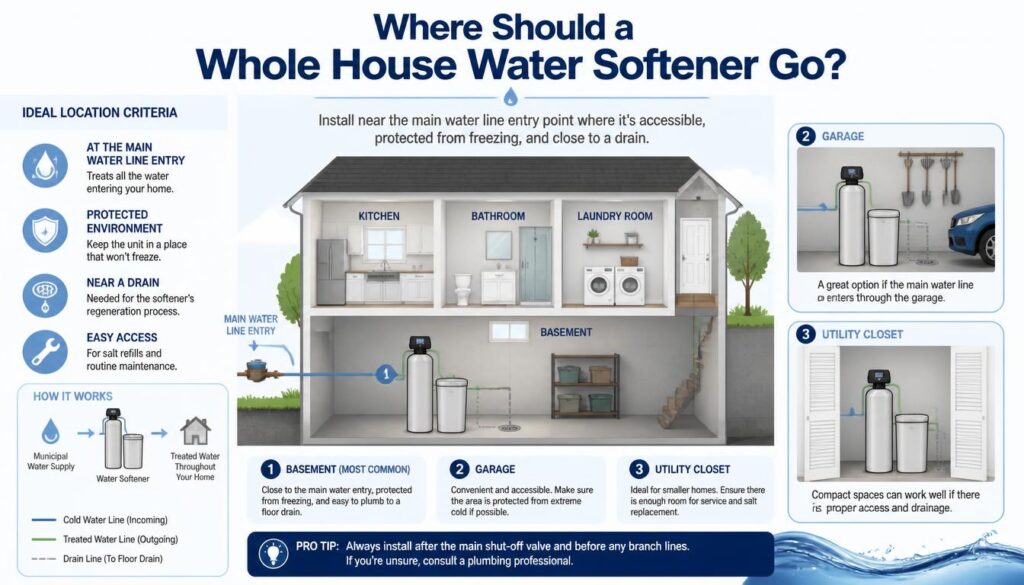
A whole house water softener generally belongs near the point where water enters the home, provided the location has adequate space, drainage and access.
A basement or garage is often convenient. A cramped crawl space can be less charming, particularly when you need to haul a 40-pound bag of salt into it and discover that gravity has suddenly become your enemy.
The installation location should provide room for maintenance, access to the plumbing supply line and a suitable regeneration drain. It should also allow the system to be bypassed if maintenance or repairs become necessary.
If you want softened water throughout the home, the system should generally be positioned so it treats the appropriate incoming supply rather than merely softening water for one distant bathroom.
What Hard Water Can Actually Do
Hard water isn’t usually dangerous simply because it is hard, but it can be a relentless nuisance.
Calcium and magnesium can create mineral buildup inside plumbing and on fixtures. Over time, scale can contribute to restricted flow and may play a role in hard water causing low water pressure, especially when combined with other plumbing problems.
You may also notice:
- Hard water stains on sinks.
- Hard water stains on tubs.
- Water spots on shower doors.
- Hard water spots on dishes.
- Reduced soap lather.
- Stiff laundry.
- More detergent use.
- Mineral deposits around faucets.
- Dry feeling skin or hair.
- Scale inside water-using appliances.
The EPA’s 2026 consumer guidance similarly notes that hard water can require more soap to lather, create scale on surfaces such as pipes, and contribute to dry skin and hair. U US EPA
That doesn’t mean every plumbing disaster is caused by hardness. Pipes age, pressure changes, corrosion happens, and sometimes a pipe simply decides it has had enough of this family.
Does a Water Softener Improve Water Quality?
It can improve certain aspects of water quality, particularly when excessive calcium and magnesium are the problem.
A properly sized ion exchange system can produce softer water, reduce scale formation and make cleaning easier. Many homeowners notice better soap lather, fewer spots on glasses and less mineral residue around bathroom fixtures.
But water softening isn’t the same as comprehensive purification.
If your water contains chlorine, VOCs, bacteria, sediment or other contaminants, you may need a separate treatment approach. A private well may require a more extensive analysis before anyone recommends a system.
This distinction is especially important when someone promises that one appliance will solve every possible water problem. Water chemistry is less interested in marketing slogans than we are.
Salt Based vs. Potassium vs. Salt Free Systems
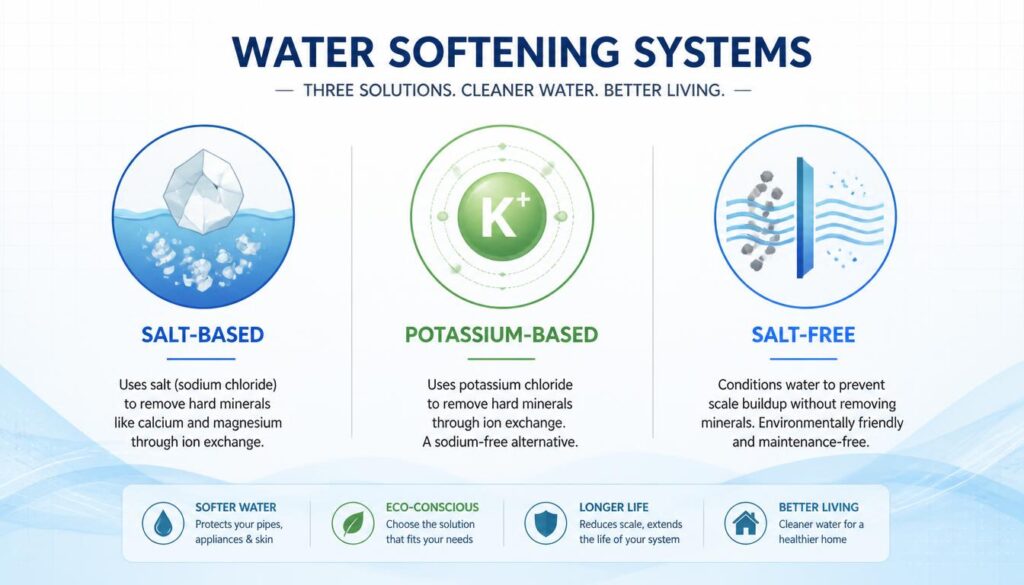
Choosing between systems comes down to what you want removed, how much you are willing to spend, and what your local water situation permits.
A sodium chloride softener is generally economical and proven for hardness removal. A potassium chloride softener can reduce sodium addition but costs more to operate.
A salt free water softener is often actually a conditioner rather than a true softener, depending on the technology, so understand what the equipment does before comparing prices.
The phrase “salt free” can sound wonderfully clean and simple. But if your objective is actual removal of calcium and magnesium through ion exchange, the technology matters more than the label.
Ongoing Water Softener Maintenance Cost
The purchase price is only the opening chapter.
Your water softener maintenance cost can include salt or potassium, occasional cleaning, resin or valve service, repairs and possibly professional inspections.
A salt based system may have an ongoing salt expense around $10 per month for a typical household, though actual usage varies with water hardness and consumption.
Potassium can push operating costs much higher, with a rough planning figure of around $50 per month in some households.
There may also be repair expenses. Current cost data places typical softener repairs around $150 to $900, with complicated repairs potentially reaching about $2,000. A n Angi
So when comparing a $700 system with a $2,000 system, don’t stare only at the purchase price. Look at regeneration efficiency, salt consumption, capacity, warranty and service availability too.
How to Get a Fair Contractor Estimate
When collecting contractor estimates, don’t simply ask, “How much to install a water softener?” Ask what is included.
A useful quote should identify the equipment, installation labor, fittings, drain connection, bypass arrangement, programming, testing, permits if required and cleanup.
Try to get at least three plumber estimates or local installer proposals when the project is substantial. Professional sources also recommend comparing several companies because installation complexity and local labor rates can change the final number considerably. A Angi+1
Ask each contractor:
- What hardness level are you sizing for?
- What grain capacity are you recommending?
- Is this a single-tank or dual tank design?
- Does the quoted price include installation?
- Are plumbing modifications included?
- Is a permit required?
- Who handles the inspection?
- What is the expected salt consumption?
- What happens if the existing plumbing leaks?
- What warranty covers labor?
- What warranty covers the equipment?
A quote that answers these questions is worth more than a suspiciously cheerful number scribbled on the back of a business card.
Is a Water Softener Worth It?
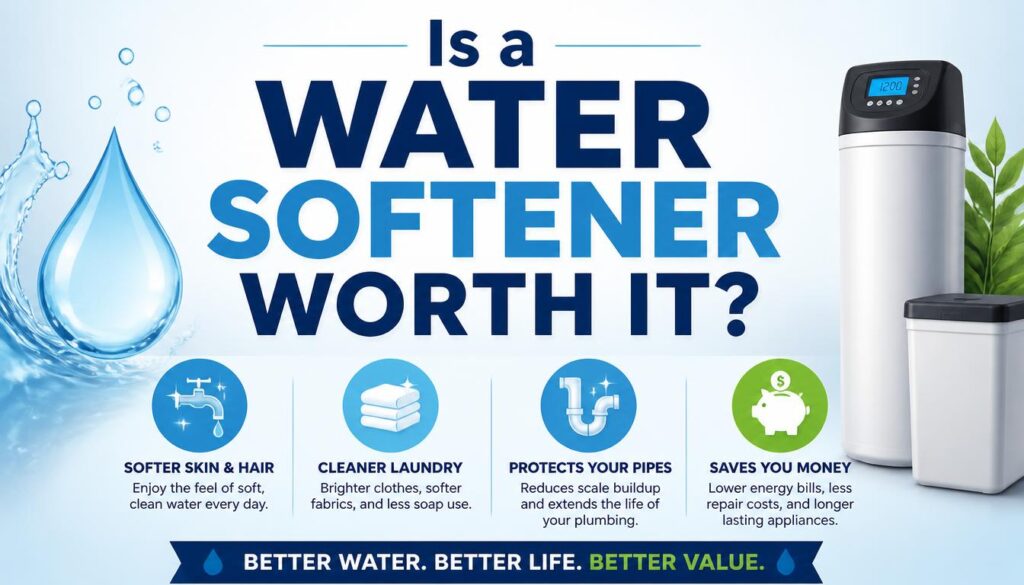
For homes with genuinely hard water, a softener can be a worthwhile investment.
The strongest case is usually practical rather than glamorous: less scale, easier cleaning, better soap performance and protection for water-using plumbing fixtures and appliances.
The EPA’s guidance notes that water hardness above roughly 120 mg/L is generally considered hard and that softening is often recommended above about 180 mg/L. U US EPA
The financial case becomes more convincing when hard water is severe, water use is high, and mineral deposits are already causing recurring maintenance headaches.
But if your water is only mildly hard, you may decide the installation doesn’t justify the expense. That’s why do I need a water softener should come after how hard is my water, not before it.
A Simple Way to Estimate Your Own Budget
Suppose you have a reasonably accessible installation point, moderate hardness and a standard single-tank system.
You might begin with:
Equipment: $500 $1,200
Professional installation: $300 $1,000
Testing: $20 $100+
Permit, if required: $20 $100
Initial supplies and fittings: variable
First-year salt: roughly $100 $200 or more depending on use
That gives you a broad planning window rather than a fake precision number.
For a complicated whole house water softener cost, particularly with new plumbing, difficult access, high capacity or dual-tank equipment, the total can move into several thousand dollars.
Current 2026 market data supports a broad overall project range reaching roughly $6,000, with specialized installations potentially exceeding that. A Angi+1
How to Choose the Correct Water Softener Size
Don’t choose a system merely because the tank looks impressively tall.
Start with your water hardness level, usually expressed in GPG. Then consider household size and water consumption. More people generally means more water, and harder water means the system has to remove more mineral load.
The basic relationship is straightforward: household water demand multiplied by hardness gives you an estimate of the hardness load the system must handle.
For example, current installation guidance illustrates a calculation using four people, 90 gallons per person per day and 10 GPG hardness, producing a weekly hardness demand of 25,200 grains. A Angi
That doesn’t mean every four-person household needs exactly a 25,200 grain unit.
Regeneration settings, reserve capacity, efficiency and manufacturer specifications matter too. It simply shows why water softener capacity should be calculated rather than guessed.
Frequently Asked Questions
How much does it cost to install a water softener in 2026?
The average cost depends on the system, labor, and plumbing work required, but most installations fall within a few hundred to several thousand dollars.
What is the average cost of a water softener?
A water softener typically costs between $500 and $3,000, including the system and installation, depending on the type and size.
How much does labor cost to install a water softener?
Professional installation labor often costs around $200 to $500, though complex plumbing or electrical work can increase the total.
What factors affect water softener installation costs?
System type, water hardness, home size, plumbing requirements, installation location, and labor rates can all affect the final cost.
Is it worth paying for professional water softener installation?
Yes, professional installation helps ensure proper connections, drainage, and system setup while reducing the risk of leaks or installation problems.
Read this Blog:https://hynoval.com/weeks-from-3-weeks-from-today/
Final Thoughts: Spend on the Water Problem, Not the Sales Pitch
The real water softener cost isn’t the number printed beside a shiny tank. It’s the price of getting the right treatment, correctly sized, safely connected and sensibly maintained.
For many homeowners in 2026, budgeting around the $1,500 national average is a reasonable starting point, while keeping the broader $500–$6,000 range in mind for different system types and installation situations. A Angi+1
Start with a water test. Find out your hardness. Check whether your home uses municipal or private well water. Decide whether you actually need mineral removal or whether filtration is the bigger issue.
Then compare a few systems and ask contractors to explain every line of their estimate.
And don’t forget the tiny details. A proper drain, a reachable bypass valve, correct programming, enough grain capacity and code-compliant plumbing are not glamorous purchases, but they are the bits that keep a softener from becoming an expensive basement ornament.
If you’re comparing the water softener installation cost for your own ZIP code, use these national figures as a starting point rather than a final quote. Local labor, regulations and plumbing conditions can shift the number quite a lot.
In the end, good water softening is less about buying the biggest machine and more about matching the treatment to the water you actually have. Test first, size carefully, install properly, and let the chemistry not the sales brochure make the final argument.