

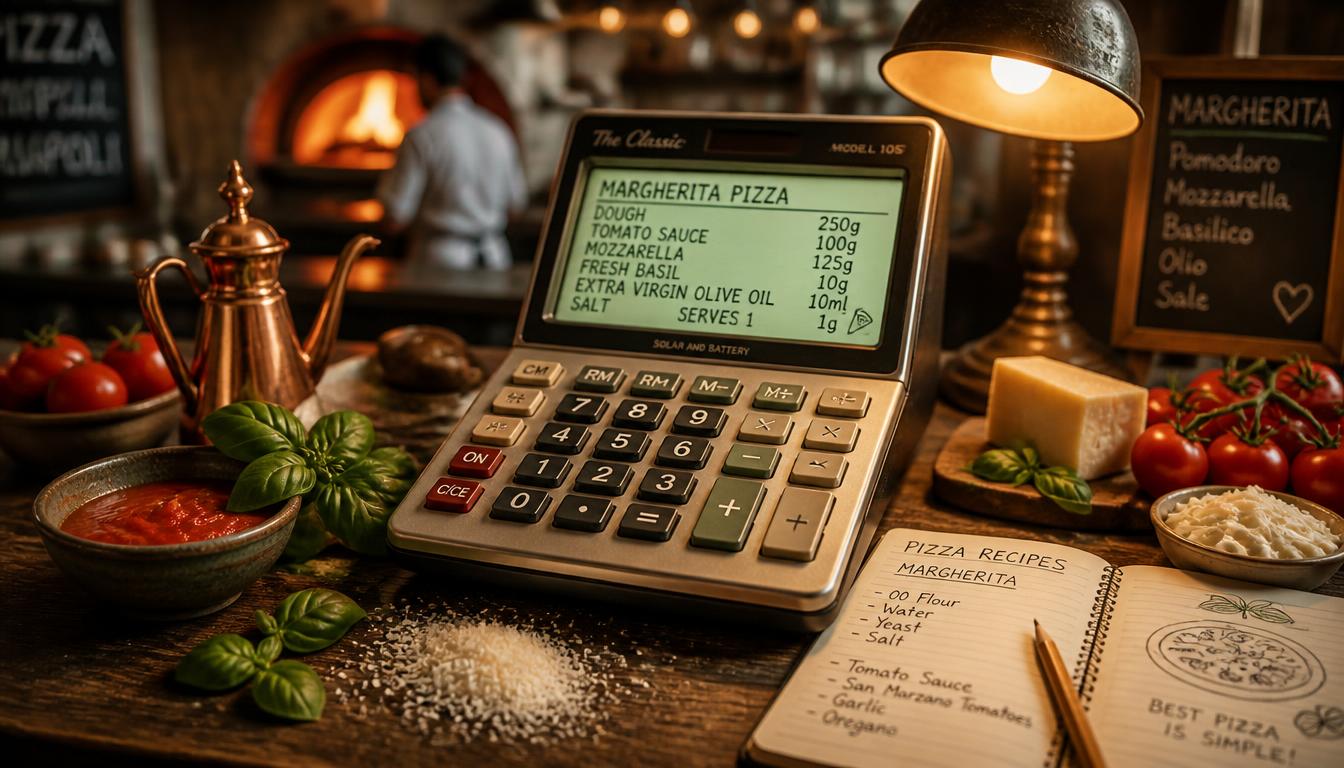
There is something wonderfully strange about welcoming a baby girl into a family: suddenly the smallest person in the room somehow becomes the biggest reason everyone is smiling.
I remember how these gatherings can feel, with relatives arriving carrying flowers, little gifts, and enough food to feed a small village, just in case.
And yes, somewhere between the congratulations and the cake, somebody usually asks the practical question nobody planned for: “So… how much pizza are we actually ordering?” It sounds simple, but it can turn into a tiny math crisis pretty quick.
That is where a Pizza Calculator becomes less like a cold mathematical tool and more like the friend who quietly counts the guests, notices who is actually hungry, and prevents the tragic sight of an empty pizza box before the evening is over.
Whether you’re arranging a birthday, a teenager birthday, a big game, a family picnic, a lunch, or a casual gathering, getting the quantity right makes the whole event feel easier.
Nobody wants twelve leftover pies when eight would have done, but nobody wants hungry guests staring hopefully into an empty cardboard box either.
| People | Large Pizzas |
|---|---|
| 10 | 4 5 |
| 15 | 6 |
| 20 | 8 |
| 25 | 9 10 |
| 30 | 11 12 |
| 40 | 15 |
| 50 | 19 |
Why a Pizza Calculator Is More Useful Than Guessing
Most people don’t really need complicated mathematics to order pizza, but guessing has a funny way of going wrong.
One person counts everyone as an adult, another assumes children will eat almost nothing, and someone else remembers that Uncle Sam once ate six pizza slices at a family party and decides everyone must be that hungry. It doesn’t quite work like that, sadly.
A good pizza quantity calculator starts with the number of people, then considers whether they’re adults and children, how hungry the crowd is, what else you’re serving, and the pizza size.
A dinner where pizza is the entire meal needs a different calculation from a party where there is salad, breadsticks, drinks, desserts, and a giant cake waiting nearby.
The basic idea is wonderfully uncomplicated: estimate slices per person, figure out how many slices your pizzas provide, then round upward when the situation calls for it.
In other words, the pizza serving calculator is really helping you translate people into slices without making your brain do gymnastics.
The Simple Pizza Formula Behind the Calculator
A commonly used starting point is around 3 slices per adult, while a child might have about 2 slices per child. A standard pizza may provide around 8 10 slices per standard pizza, although this varies by restaurant and pizza size.
Those numbers are not sacred tablets brought down from a mountain; they’re practical estimates, and real appetites are gloriously unpredictable.
For a simple adult-only estimate, one useful pizza formula is p = 3a/8, where p represents the number of pizzas and a represents the number of guests. The formula assumes roughly three slices per guest and eight slices per pizza.
If you have 16 adults, for example, 16 × 3 gives 48 slices, and 48 ÷ 8 gives 6 pizzas. Easy enough, though I’d still round up if the crowd has been talking about pizza all week.
The 3/8 ratio essentially means you’re estimating about 3/8 of a pizza per person when each pie has eight slices. This can be a useful pizza ordering formula, but don’t treat it like law.
A thin crust may disappear faster than a filling deep dish, and a hungry group of teenagers can make mathematical predictions look very silly indeed.
Pizza Calculator by Number of Guests
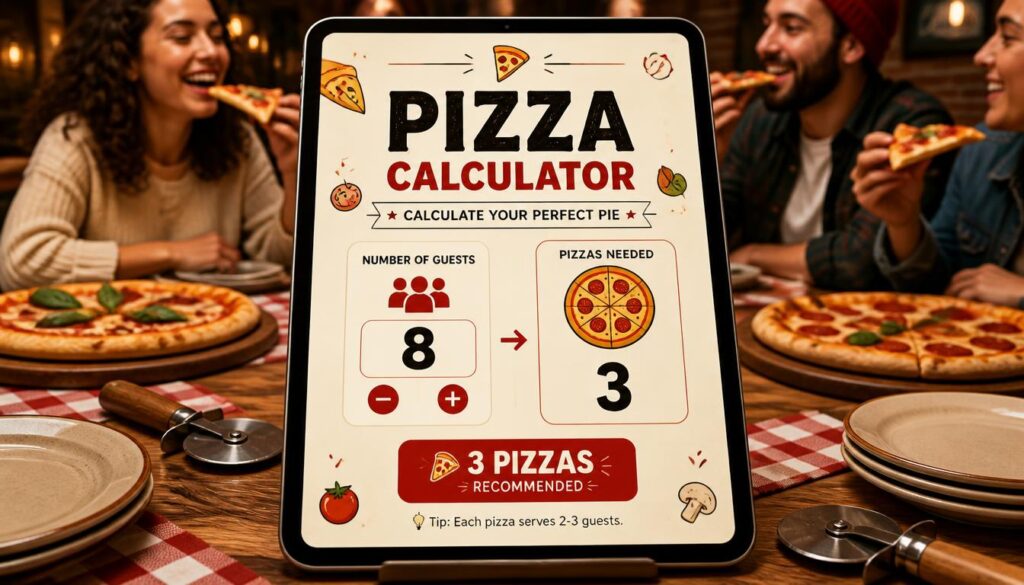
For quick planning, here’s a practical starting point for adult guests. These estimates assume roughly three slices per adult and pizzas cut into eight slices. If pizza is the main meal and your guests are especially hungry, adding an extra pie is usually the calmer choice.
- 5 guests: Around 2 pizzas should be comfortable, with a little breathing room.
- 10 guests: Plan on about 4 pizzas, especially if pizza is the main food.
- 15 guests: About 6 pizzas is a sensible starting point.
- 20 guests: Around 8 pizzas should cover a typical dinner crowd.
- 25 guests: Plan for roughly 10 pizzas, or a little more for hungry guests.
- 30 guests: Around 12 pizzas gives you a straightforward starting estimate.
- 40 guests: About 15 pizzas may work, with extra food pushing the number down slightly.
- 50 guests: Roughly 19 pizzas is a useful estimate for a pizza-heavy meal.
These numbers are intentionally practical rather than pretending every human eats the same way.
A group of pizza lovers at a late-night party can eat substantially more than a room full of polite guests nibbling pizza alongside a full buffet, so your pizza order calculator should always leave some space for common sense.
Pizza for Adults, Children, and Teenagers
Children are often harder to predict than adults because “I’m not hungry” can be followed by “Can I have another slice?” approximately nine seconds later. A reasonable starting point is 2 slices per child, while 3 slices per adult is a useful estimate.
For a mixed group, calculate the two groups separately and then add them together, which is much less confusing than trying to invent one magical average.
Teenagers deserve their own little warning label in party planning. A teenager birthday with fifteen teenagers can require far more food than fifteen adults sitting at a formal dinner.
If pizza is the star attraction, planning around three slices per teenager may be sensible, with extra pizza available if the party lasts several hours. Teenagers have a special talent for discovering food that adults thought was “plenty.”
For a family gathering, you might have 10 adults and 10 children. Using three slices for each adult and two for each child gives 30 + 20 = 50 slices. If your pizzas have eight slices each, that means a little over six pizzas, so ordering 7 pizzas gives you a useful cushion.
This is where a pizza serving calculator for adults and children becomes genuinely handy rather than just decorative.
How Many Pizzas Should I Order for a Party?
The question how many pizzas should I order for a party sounds like it deserves one perfect number, but parties refuse to behave that neatly.
The best answer depends on the time of day, the length of the event, and whether people are arriving already hungry or have just finished lunch. Food planning is partly mathematics and partly educated guessing, honestly.
For a birthday party held around dinner time, pizza should generally be treated as a main meal. If you’re hosting a shorter afternoon event with snacks and cake, you may need less.
A two hour evening party where pizza is served at 7 p.m. will almost always require more than a casual afternoon gathering where people are eating between conversations.
A useful trick is to ask yourself, “If the pizza disappeared 20 minutes early, would everyone be annoyed?” If the answer is yes, add a pizza or two. The extra pie is usually less painful than watching the final slice get divided into six suspiciously tiny triangles by hungry guests.
Pizza Size Matters More Than People Think
Not every pizza is created equal, and the word “large” can be surprisingly slippery. One restaurant’s large pizza may be 14 inches, while another pizzeria may use a different diameter.
That’s why looking at the actual pizza diameter and number of slices is smarter than relying only on size labels.
A 14 inch pizza is often a popular group serving option, and many pizzas in this range are cut into eight slices. But the number of slices doesn’t tell the whole story, because a bigger pizza has considerably more surface area than a smaller one.
A pizza size calculator can therefore be more useful when you’re comparing pies from different restaurants, not merely counting slices.
If you’re choosing between several medium pizzas and fewer large pizzas, compare the total pizza area and price rather than simply counting boxes. Sometimes the largest size gives better pizza value, while sometimes several smaller pizzas make it easier to offer different toppings.
The cheapest looking order isn’t always the cheapest way to feed everyone, which is one of those party-planning lessons people learn once and never forget.
Classic Crust, Thin Crust, or Deep Dish?
Crust changes the appetite equation in sneaky ways. A classic crust tends to provide a familiar balance of toppings, cheese, and dough, while thin crust can feel lighter and allow guests to eat more slices.
A deep dish pizza is much more substantial, so counting it exactly like a thin pie can leave you with enough leftovers to survive a snowstorm.
If you’re feeding a mixed crowd, ordering different pizza styles can actually make the quantity easier to manage. One classic pie, a couple of thin-crust options, and a hearty deep dish choice give people different experiences without requiring one enormous pile of identical pizzas.
Variety also makes the table look more generous, which is a small trick but it works.
The important thing is to ask the pizzeria how many slices each size normally produces. An 8 slice pizza and a 10 slice pizza are not interchangeable when you’re doing precise serving calculations.
Your calculator can only be as accurate as the information you put into it, and pizza, for all its greatness, doesn’t always respect standard measurements.
Don’t Forget Dietary Requirements
A pizza party can become awkward very quickly when somebody discovers there is nothing they can eat.
Before placing a bulk order, ask about dietary restrictions and special dietary needs, especially when you’re inviting families, coworkers, or organization members who may have different preferences.
A few meat-free pizza options can cover vegetarian guests, while a dairy free pizza may be important for people avoiding dairy.
If you have gluten-free guests, ask the restaurant about its gluten-free pizza preparation and whether it uses separate equipment where appropriate. The exact level of cross contact risk depends on the pizzeria, so it’s worth asking rather than making assumptions.
It can also help to label the boxes when they arrive. “Vegetarian,” “gluten-free,” and “dairy free” written clearly on the lid saves everyone from opening six boxes and performing an accidental cheese inspection.
It’s a tiny organizational detail, but at a busy gathering it can feel like somebody secretly hired a professional caterer.
What to Serve With Pizza
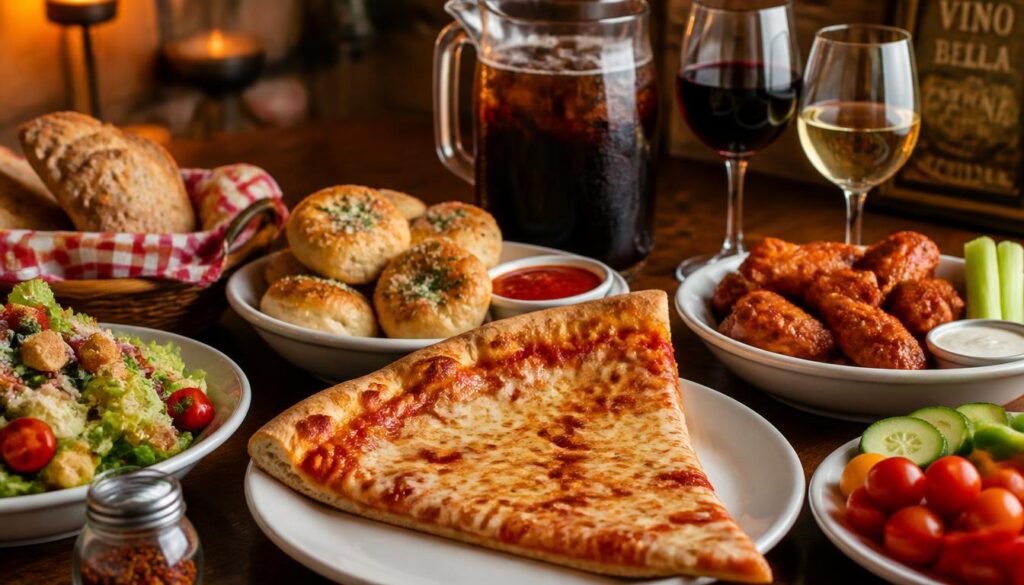
Pizza doesn’t have to carry the entire event on its cheesy shoulders. Adding salad gives guests something fresh, while breadsticks can stretch the meal without requiring another complete pizza.
Drinks are obvious companions, and a dessert table with cake or other desserts can make the whole meal feel more complete.
If you’re feeding a large group, sides can also change your pizza quantity. A substantial salad, several trays of breadsticks, and dessert mean people may eat fewer slices.
But don’t reduce the pizza dramatically just because you’ve bought sides; hungry people have a remarkable ability to eat the side dishes and then return for more pizza anyway.
For a traditional mealtime, such as lunch or dinner, think of pizza as the centerpiece and sides as supporting characters. At a family picnic, however, people may eat in waves rather than all at once, which makes a slightly larger quantity useful.
Food planning is partly about numbers, but also about how humans actually behave around food, and humans are not especially predictable.
Pizza Calculator Tips for Different Events
A big game often calls for more pizza than a formal dinner because people snack continuously for hours. Guests may grab one slice, wander away, return for another, and then suddenly discover that three slices have somehow disappeared.
For game day, a small buffer is wise, especially if drinks and snacks are keeping everyone around longer.
A family picnic works differently. People may bring their own dishes, children might eat less than expected, and pizza could be only one part of the meal.
In that case, use your calculated number as a starting point and reduce it modestly if there is plenty of other substantial food. Nobody will complain about having another choice on the picnic table.
For a workplace lunch gathering, predictability is usually your friend. Ask whether people prefer meat, vegetarian options, or other dietary choices before ordering.
If you’re feeding organization members, keeping the menu varied and clearly labeled is often more appreciated than ordering the absolute maximum number of pizzas.
Pizza Ordering and Saving Money
Once you know the number of pizzas needed, the next question is often money. Before placing a large-volume order, check for pizza deals, bulk discounts, or pizzeria specials.
A large order may qualify for a different price structure than ten individual orders, so ask rather than assuming the menu price tells the whole story.
Compare delivery charges with pizza pickup, especially for a large volume order. Delivery is wonderfully convenient, but multiple delivery fees can quietly turn a good pizza deal into a not so good pizza deal.
If someone can collect a pre-arranged pickup order, you may save money without changing the amount of food at all.
It is also worth checking whether sides or freebies are included with certain packages.
Sometimes a deal containing breadsticks and drinks is better value than buying every item separately, while other times the cheapest approach is simply ordering the right number of large pizzas.
The best pizza cost strategy is rarely complicated; it just requires reading the deal properly before getting excited about a giant discount sticker.
A Quick Pizza Ordering Example

Imagine you’re hosting 20 people for dinner, including 14 adults and 6 children. The adults need roughly 42 slices, while the children need about 12 slices, giving you 54 slices altogether.
If your pizzas provide eight slices each, you need 6.75 pizzas, so ordering 7 pizzas is the natural choice.
Now imagine those same 20 people are attending a party with salad, breadsticks, drinks, and cake. Seven pizzas might still be perfectly reasonable, but six could potentially work depending on how substantial the sides are.
If the group includes especially hungry pizza lovers, however, seven is the safer number. The calculator gives you the starting point; your knowledge of your own crowd finishes the job.
Pizza Calculator Versus a Cake Calculator
It may sound funny to compare a Pizza Calculator with a cake calculator, but party planning has a habit of turning every food into mathematics.
The cake calculator asks how many servings you need, while the pizza calculator asks how many pies and slices will keep everyone reasonably happy. Both are really tools for avoiding the same problem: running out of food at the wrong moment.
For events where pizza and cake are both important, calculate them separately.
Pizza is usually eaten as a meal, while cake is served in smaller portions at the end.
Ordering enough pizza to compensate for a giant cake doesn’t make much sense, and neither does buying an enormous cake because you’ve ordered fewer pizzas. Each food has its own role, bless it.
How to Write a Custom Message for a Pizza Party
If you’re sending congratulations for a new baby girl and the celebration includes pizza, a message can be warmer than a generic “Congratulations!” Try connecting the food, the gathering, and the family moment without forcing the joke too hard.
A little personality goes much further than a sentence that sounds like it was printed on a supermarket card.
Here are a few adaptable messages you can use:
- “Congratulations on your beautiful baby girl! May her life be filled with love, laughter, and just enough pizza to keep every family gathering cheerful.”
- “A tiny daughter has arrived, and suddenly the whole family has a brand-new reason to celebrate. Wishing you endless cuddles, peaceful nights, and very generous pizza portions.”
- “Welcome to the world, little one. Your family has been waiting for you, and apparently they’ve also ordered enough pizza for everyone.”
- “Congratulations on welcoming your daughter! May her childhood be full of warm hugs, silly stories, family gatherings, and the occasional extra slice.”
- “To the proud parents: your sweetest little guest has finally arrived. May your home be noisy with laughter and never mysteriously short on pizza.”
- “A beautiful baby girl, a room full of happy faces, and probably a table full of food that sounds like a celebration worth remembering.”
- “May your daughter grow surrounded by people who love her fiercely, laugh with her loudly, and always save her the last slice.”
- “Congratulations on this wonderful new chapter. Babies may be tiny, but somehow they make every celebration feel enormous.”
- “Wishing your family newborn blessings, peaceful moments, and enough pizza to welcome every relative who says, ‘I’ll only stay for a few minutes.’”
- “Here’s to your little girl, her bright future, and a lifetime of family meals where somebody is always reaching for one more slice.”
These messages work because they don’t try too hard to be clever.
A parent may forget the exact wording of a congratulations card years from now, but they’ll remember that people showed up, celebrated their daughter, brought warmth, and made the ordinary meal feel special. That’s the bit that matters most, really.
Cultural Touches That Make Celebrations Feel Personal

Across many cultures, welcoming a new baby is closely connected with food and family.
Relatives gather, elders offer blessings, guests bring gifts, and meals become a way of saying “we’re here for you” without needing a long speech. The exact customs differ widely, of course, but hospitality appears again and again in newborn celebrations.
In some families, sweets are shared to mark a joyful arrival; in others, a large family meal brings several generations together. Some parents prefer a quiet gathering at home, while others invite a whole crowd.
There isn’t one correct way to welcome a baby girl, and that flexibility is part of what makes these celebrations beautiful.
One grandmother once described a family gathering to me in the simplest possible way: “We didn’t need a perfect party. We just needed everybody in the same room.” That sentiment applies to pizza parties too, strangely enough.
The food can be imperfect, the boxes can arrive a little late, and someone will definitely forget the napkins, but the memory can still be lovely.
How Many People Does a Large Pizza Feed?
A large pizza may feed around two to four people when it is the main meal, depending heavily on its diameter, slice size, crust, and appetite. Saying that one large pizza always feeds exactly three people is too rigid for real world party planning.
A room full of hungry teenagers and a room full of small children are clearly not the same calculation.
If your restaurant’s large pizza is a 14 inch pizza cut into eight slices, you can begin with the three slices per adult estimate. From there, adjust according to sides and appetite.
This approach is more reliable than simply searching for “how many people does a large pizza feed” and accepting one universal number, because pizza sizes vary from place to place.
The same logic applies when deciding how many slices of pizza per person. Three slices is a practical adult estimate, two is a useful child estimate, and teenagers may need more.
The calculator isn’t trying to predict every bite; it’s helping you make a sensible order without staring at the ceiling and hoping for divine pizza guidance.
The Human Side of Feeding a Crowd
There is a funny emotional part of feeding a crowd that calculators can’t measure. When somebody arrives at a party and sees a table full of food, they feel welcomed before they’ve even eaten anything.
A well planned pizza order quietly communicates generosity, preparedness, and “please, have another slice,” which is a pretty lovely message to send.
That’s especially true for families celebrating something meaningful, whether it’s a new baby girl, a birthday, an engagement, graduation, or simply an overdue family reunion.
The pizza isn’t the memory itself. It is the warm little vehicle carrying conversation, jokes, stories, and second helpings around the room.
So use the numbers, absolutely, but don’t become trapped by them.
A pizza portion calculator can tell you that seven pizzas should work; your knowledge of the people sitting at the table can tell you whether seven is cautious, generous, or wildly optimistic. Trust both pieces of information.
Frequently Asked Questions
how many pizzas for 40 people
For 40 people, you’ll need about 15 large pizzas.
how many pizzas for 10 people
For 10 people, you’ll need about 4 5 large pizzas.
how many pizzas for 15 people
For 15 people, you’ll need about 6 large pizzas.
how many pizzas for 50 people
For 50 people, you’ll need about 19 large pizzas.
how many pizzas for 25 people
For 25 people, you’ll need about 9 10 large pizzas.
Read This Blog:https://hynoval.com/sae-to-metric-calculator-sae15-32/
Final Thoughts: Let the Calculator Do the Counting
The best Pizza Calculator isn’t really about mathematics. It is about reducing one small piece of party stress so you can spend more time enjoying the people who came.
Start with your party size, estimate pizza servings per person, account for adults and children, check the actual pizza size, consider dietary needs, and then add a modest safety margin when the crowd is particularly hungry.
For a simple event, the pizza formula p = 3a/8 can provide a quick starting point, while a more detailed calculation can account for children, teenagers, sides, crust type, and different pizza sizes.
Whether you’re figuring out pizzas for 5 people, pizzas for 10 people, pizzas for 20 people, or a crowd of 50, the same basic principle holds: estimate sensibly, then leave a little room for real life.
And if this calculator is being used for a celebration welcoming a baby girl, remember that the most important part isn’t whether you ordered 6, 7, or 8 pizzas.
Years from now, nobody will lovingly recall the exact number of pizzas on the table.
They’ll remember the tiny girl everyone came to meet, the grown ups laughing too loudly, the children running around, the grandparents smiling, and that lovely feeling that for one evening, everybody had somewhere they wanted to be.
If you’ve got a favorite pizza ordering trick, a family rule for feeding hungry guests, or a story about a celebration where the pizza disappeared much too quickly, share it.
Somebody planning their next pizza party will probably be very grateful for the wisdom, and maybe slightly less nervous about ordering the right number of boxes.