

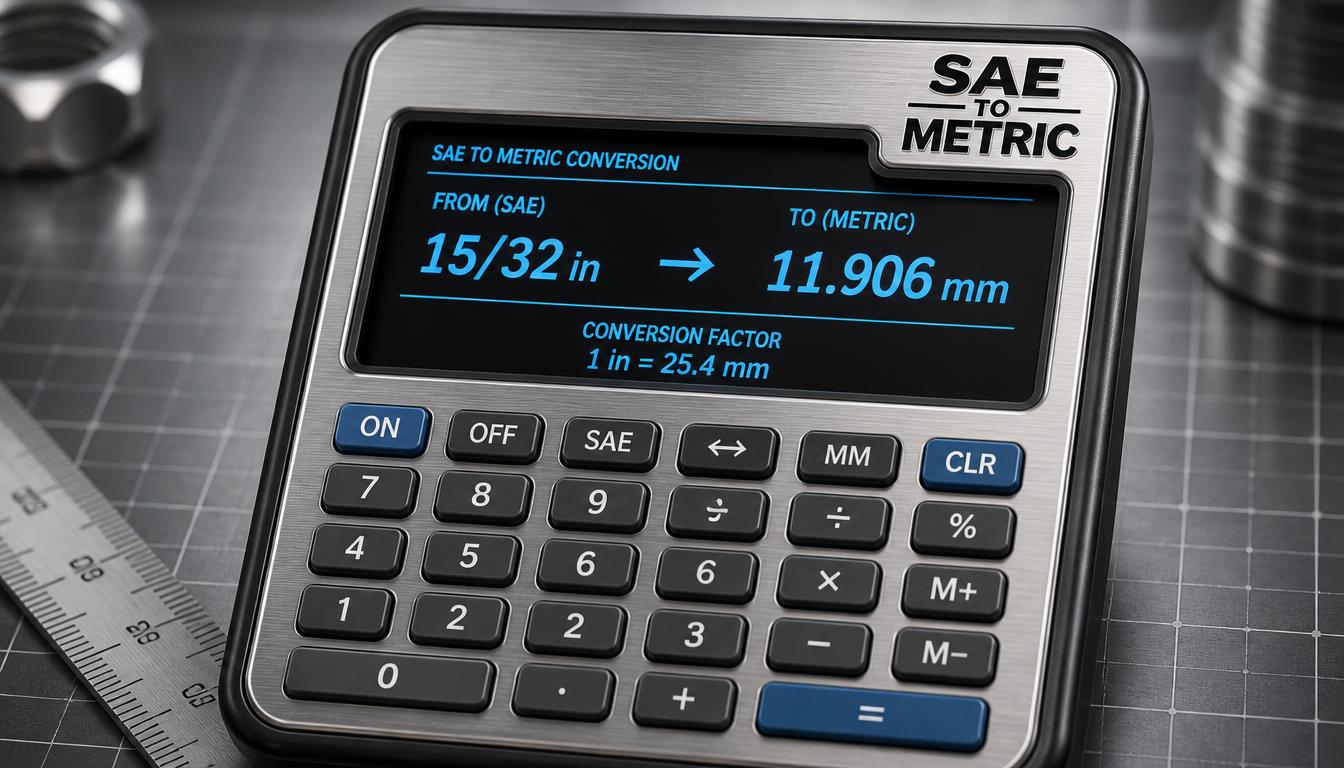
There is a funny little moment that happens when a measurement written on a socket, bolt, or old workshop note suddenly looks like a secret code. 15/32 inch is one of those measurements.
You see the fraction, reach for a wrench, and then wonder, “Alright, but what is that in mm?” It sounds tiny, almost trivial, yet getting the metric equivalent right can save a surprising amount of time, specially when an American-made tool meets a metric fastener.
The good news is that 15/32 inch to mm is wonderfully straightforward once the fraction is turned into a decimal. The exact answer is 11.90625 mm, or approximately 11.91 mm when a practical rounded value is enough.
So if you’ve been searching for 15/32 to mm, 15/32 inch to mm, or even “15/32″ in mm,” you’ve landed on the right little corner of measurement land, where fractions and millimeters finally shake hands.
| SAE | Metric (mm) |
|---|---|
| 15/32″ | 11.91 mm |
| 7/16″ | 11.11 mm |
| 1/2″ | 12.70 mm |
| 9/16″ | 14.29 mm |
| 5/8″ | 15.88 mm |
| 11/16″ | 17.46 mm |
| 3/4″ | 19.05 mm |
15/32″ = 11.90625 mm ≈ 11.91 mm
15/32 inch to mm: The Quick Answer
For anyone who needs the answer right away, here it is without making you dig through a mountain of numbers. 15/32 inch = 0.46875 inch = 11.90625 mm, which is approximately 11.91 mm.
In many workshop situations, you may also see it treated as roughly 12 mm, although that is a rounded comparison rather than an exact conversion, so don’t confuse the two.
The conversion works because 1 inch = 25.4 mm, exactly. That conversion factor isn’t an estimate or an old machinist’s guess; it is the fixed relationship used for Inch to Millimeter Conversion. Once you know that, the whole business gets much less mysterious, honestly.
- 15/32 inch = the original fractional measurement, pretty handy on an SAE tool.
- 0.46875 inch = the same measurement written as an inch decimal.
- 11.90625 mm = the exact metric result.
- 11.9063 mm = a rounded result to four decimal places, which is usually plenty.
- 11.91 mm = a convenient two-decimal result for everyday work.
- Approximately 0.469 inch = the same value rounded back toward decimal inches, just for comparison.
- About 12 mm = a nearby metric size, but not an exact equivalent, so use some judgement before grabbing that socket.
If you’re looking for a SAE to Metric Calculator, the important thing is that the calculator should preserve enough decimal precision before rounding.
Rounding too early can make a small measurement drift farther than you’d expect, and little errors have a habit of becoming annoying errors once metal parts get involved.
How 15/32″ Becomes 11.90625 mm
The first step in SAE to Metric Conversion is turning the fraction into decimal inches. With 15/32″, divide 15 by 32. The result is 0.46875 inch. Nothing dramatic happened there, although fractions do sometimes look more intimidating than they really are.
Next, multiply the decimal inches by 25.4 because 1 inch = 25.4 mm. So the calculation is:
0.46875 × 25.4 = 11.90625 mm
That is the entire inch-to-mm conversion in its cleanest form. If you prefer working directly with the fraction, you can also calculate 15 ÷ 32 × 25.4, which gives exactly the same result, and that method is rather nice when you’re standing at a workbench with a calculator in one hand.
A smaller example makes the idea even clearer. Take 1/4 inch. First, 1 ÷ 4 = 0.25. Then 0.25 × 25.4 = 6.35 mm. So 1/4 inch = 0.25 inch = 6.35 mm.
Once you understand that little sequence, you can convert practically any fractional inch measurement without needing a special trick, which is pretty useful stuff.
What Does SAE Mean, Anyway?

The letters SAE are associated with the Society of Automotive Engineers (SAE), an organization with a long history in engineering and automotive standards.
In everyday tool talk, though, people commonly use “SAE” to describe inch-based standard sizes, especially for sockets, wrenches, and fasteners. It can be a bit loose in ordinary conversation, but you will hear it constantly in garages and workshops.
The system people call SAE is based on inches and often uses fractional inches such as 1/4″, 3/8″, 1/2″, and 15/32″.
It is closely related to what people call the standard measurement system, Imperial measurement system, or U.S. customary measurement system, although those labels aren’t perfectly interchangeable in every technical context.
Toolboxes, naturally, don’t care much about the philosophical differences.
By contrast, the metric system uses millimeters, centimeters, meters, and other decimal-based units.
A metric socket might say 10 mm, 11 mm, 12 mm, or 13 mm, while an SAE socket could be marked 3/8″, 7/16″, 1/2″, or 15/32″. It feels like two toolboxes speaking two dialects, which is why conversion charts are so handy.
15/32 to mm for Sockets and Wrenches
If you have a 15/32 socket size, the precise dimensional conversion is 11.90625 mm. But here’s the workshop catch: a 12 mm socket is not mathematically identical to a 15/32″ socket.
A 12 mm socket is exactly 12 mm across the relevant nominal dimension, while 15/32″ is 11.90625 mm. The difference is only about 0.09375 mm, but “only” can become a dangerous word when a fastener is already worn.
For a clean, undamaged fastener, the correct tool is generally the one designed for that fastener’s actual size. Substituting a near size may work in an emergency, but it isn’t something to celebrate with a victory dance.
A loose fitting socket can round the fastener, especially if corrosion or high torque is already part of the story.
- A 15/32″ socket corresponds exactly to 11.90625 mm, not exactly 12 mm.
- A 12 mm socket is approximately 0.47244 inch, so it is slightly larger.
- The difference between 15/32″ and 12 mm is small, but measurable.
- For precision work, use the correct SAE size whenever possible.
- For casual work, a nearby metric size may occasionally function, but check the fit first.
- Don’t force a socket onto a damaged fastener just because the numbers look nearly identical, thats asking for trouble.
- Keep both SAE sockets and metric sockets available if you regularly work on mixed equipment.
The same thinking applies to SAE wrenches and metric wrenches. A wrench that is close in size may appear to fit perfectly until torque is applied. Then the wrench slips, the knuckles meet the nearest hard object, and suddenly the conversion chart seems like the most important document in the universe.
A Handy SAE to Metric Conversion Chart
A SAE to Metric Conversion Chart is useful because your brain should not have to perform fraction arithmetic every time you need a wrench.
The following common values show how fractional inches relate to millimeters. Remember, these are dimensional equivalents, not promises that one nearby tool size can safely replace another.
- 1/32″ = 0.03125″ = 0.79375 mm
- 1/16″ = 0.0625″ = 1.5875 mm
- 5/64″ = 0.078125″ = 1.984375 mm
- 3/32″ = 0.09375″ = 2.38125 mm
- 7/64″ = 0.109375″ = 2.778125 mm
- 1/8″ = 0.125″ = 3.175 mm
- 5/32″ = 0.15625″ = 3.96875 mm
- 3/16″ = 0.1875″ = 4.7625 mm
- 7/32″ = 0.21875″ = 5.55625 mm
- 1/4″ = 0.25″ = 6.35 mm
- 9/32″ = 0.28125″ = 7.14375 mm
- 5/16″ = 0.3125″ = 7.9375 mm
- 11/32″ = 0.34375″ = 8.73125 mm
- 3/8″ = 0.375″ = 9.525 mm
- 13/32″ = 0.40625″ = 10.31875 mm
- 7/16″ = 0.4375″ = 11.1125 mm
- 15/32″ = 0.46875″ = 11.90625 mm
- 1/2″ = 0.5″ = 12.7 mm
- 17/32″ = 0.53125″ = 13.49375 mm
- 9/16″ = 0.5625″ = 14.2875 mm
- 19/32″ = 0.59375″ = 15.08125 mm
- 5/8″ = 0.625″ = 15.875 mm
- 21/32″ = 0.65625″ = 16.66875 mm
- 11/16″ = 0.6875″ = 17.4625 mm
- 23/32″ = 0.71875″ = 18.25625 mm
- 3/4″ = 0.75″ = 19.05 mm
- 25/32″ = 0.78125″ = 19.84375 mm
- 13/16″ = 0.8125″ = 20.6375 mm
- 27/32″ = 0.84375″ = 21.43125 mm
- 7/8″ = 0.875″ = 22.225 mm
- 29/32″ = 0.90625″ = 23.01875 mm
- 15/16″ = 0.9375″ = 23.8125 mm
- 1″ = 1.0″ = 25.4 mm
This is why a SAE size chart can be more useful than memorizing dozens of conversions. You don’t need to carry every fraction around in your head; just know the conversion factor and have a reliable reference nearby, thats plenty.
Common Metric Sizes and Their SAE Neighborhood
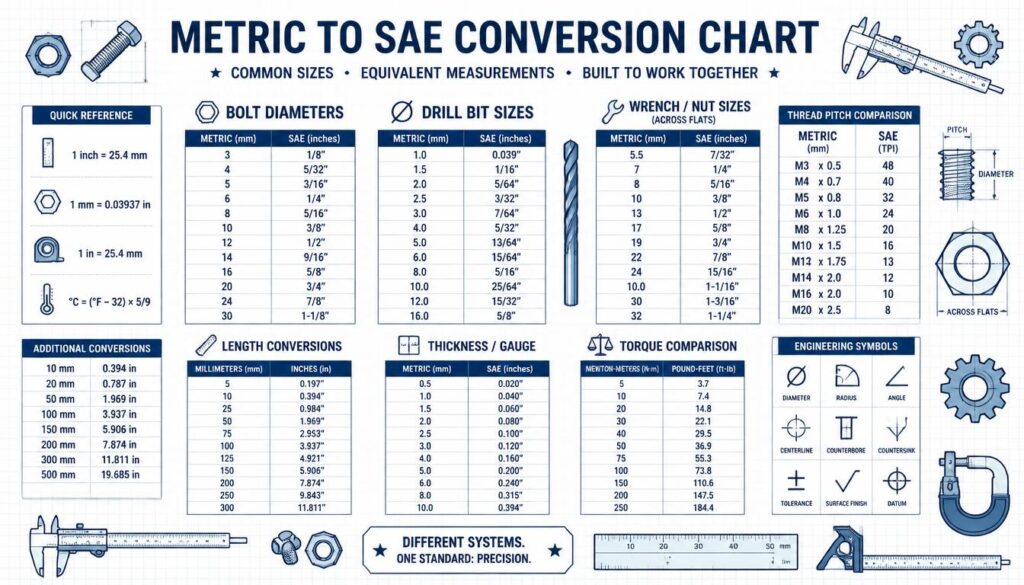
The metric side has its own familiar collection of sizes.
Common metric socket sizes and metric wrench sizes include 1 mm, 2 mm, 3 mm, 4 mm, 4.5 mm, 5 mm, 5.5 mm, 6 mm, 6.5 mm, 7 mm, 8 mm, 9 mm, 10 mm, 11 mm, 12 mm, 13 mm, 14 mm, 15 mm, 16 mm, 17 mm, 18 mm, 19 mm, 20 mm, 21 mm, 22 mm, 23 mm, 24 mm, and 25.4 mm.
These don’t line up perfectly with SAE sizes, which is an important point people sometimes skip. For example, 1/2″ = 12.7 mm, so it sits between common 12 mm and 13 mm metric sizes. Likewise, 7/16″ = 11.1125 mm, putting it near 11 mm, but not exactly at 11 mm.
- 1/4″ = 6.35 mm, near the 6.5 mm neighborhood.
- 5/16″ = 7.9375 mm, very close to 8 mm.
- 3/8″ = 9.525 mm, between 9 mm and 10 mm.
- 7/16″ = 11.1125 mm, slightly larger than 11 mm.
- 15/32″ = 11.90625 mm, just below 12 mm.
- 1/2″ = 12.7 mm, between 12 mm and 13 mm.
- 9/16″ = 14.2875 mm, between 14 mm and 15 mm.
- 5/8″ = 15.875 mm, close to 16 mm.
- 3/4″ = 19.05 mm, close to 19 mm.
- 1″ = 25.4 mm, exactly.
Those “close to” relationships can be useful for identification, but they aren’t a substitute for proper measurement conversion. A mechanic may recognize a fastener as being near 12 mm by eye, yet that doesn’t make a 12 mm tool the correct choice for every 15/32″ fastener.
SAE to Metric Conversion: Why Fractions Feel Tricky
The hardest part of SAE to Metric Conversion usually isn’t the millimeter multiplication. It’s the fraction. Humans are generally comfortable with 0.5 and 0.75, but throw 15/32 into the conversation and suddenly everyone wants coffee and a calculator.
The key is fraction-to-decimal conversion. Divide the top number by the bottom number.
For 15/32, that means 15 ÷ 32 = 0.46875. Then perform decimal to millimeter conversion by multiplying by 25.4. Simple, yes, but it becomes much easier when you treat every conversion as the same two-step dance.
- Step 1: Convert the inch fraction into decimal inches.
- Step 2: Multiply decimal inches by 25.4.
- Step 3: Keep the precision you need before rounding.
- Step 4: Compare the result with a metric size only after finding the exact value.
- Step 5: Use the exact size for critical fastener measurement whenever possible.
- Step 6: Remember that a nearby metric tool isn’t automatically an equivalent tool.
- Step 7: If you’re unsure, measure the fastener instead of guessing, because metal has very little sympathy for guesses.
This process works for screw measurement, hardware dimensions, woodworking, engineering drawings, and plenty of other situations. It isn’t just a socket trick, though sockets and wrenches are where most people meet the problem in real life.
Understanding Standard (SAE) to Metric Without the Confusion
People often say Standard (SAE) to Metric, Imperial to Metric Conversion, or “standard to metric conversion” as though they all describe one perfectly identical system.
In everyday hardware conversations, the terms overlap enough that the meaning is usually clear, but technically the terminology has some history behind it.
The SAE label is especially common around automotive and mechanical tools in the United States. The metric system, meanwhile, is the dominant measurement system in most of the world and uses millimeters for many small mechanical dimensions.
When equipment crosses borders, the two systems inevitably meet, and thats when conversion charts become everyone’s quiet best friend.
It is also worth remembering that a metric equivalent is a mathematical relationship, not necessarily a commercially available tool size. You can convert 15/32″ to 11.90625 mm, but that doesn’t mean you will walk into a hardware shop and find an 11.90625 mm socket.
Tools are manufactured in practical standardized sizes, which is why common socket sizes don’t always mirror every possible conversion result.
SAE Sizes, Fasteners, Screws, and Real Workshop Problems

The difference between an exact conversion and a practical tool size becomes especially important with fasteners. Bolts, nuts, and screws can look almost identical while using different sizing systems.
A 15/32″ measurement might refer to a particular dimension of a component, but the fastener’s thread specification can involve diameter, pitch, length, and other details too.
For SAE screw sizes, the diameter and thread information are not the same thing as simply converting a head size from inches to millimeters. Likewise, metric screw sizes use their own conventions.
So if you’re identifying a screw, don’t stop after measuring the head with a ruler and announcing victory, because there’s usually another chapter hiding underneath.
A useful little habit is to record both the original size and its metric conversion. For example, write “15/32″ = 11.90625 mm” in a workshop note. That way, the next person who opens the drawer doesn’t have to conduct the same archaeological dig through fractions all over again.
A Simple SAE to Metric Calculator Method
You don’t always need an online SAE to Metric Calculator. A basic calculator, phone, or even a scrap of paper is enough if you know the method. For any inch measurement, use the relationship Inch decimal × 25.4 = millimeters.
For a fractional measurement, convert the numerator and denominator first.
If the measurement is 15/32″, enter 15 ÷ 32, giving 0.46875. Then multiply by 25.4, giving 11.90625 mm. It’s a tiny calculation, but writing the steps out can prevent those classic “wait, why did I get 11.4?” moments.
For example, with 1/4 inch:
- 1 ÷ 4 = 0.25
- 0.25 × 25.4 = 6.35 mm
- Therefore, 1/4 inch = 6.35 mm
For another common value, 1/2 inch:
- 1 ÷ 2 = 0.5
- 0.5 × 25.4 = 12.7 mm
- Therefore, 1/2 inch = 12.7 mm
Once you’ve got this pattern, you can convert inches to millimeters pretty much whenever you need to, without relying on memory for individual sizes.
When Should You Round 15/32″ to 12 mm?
This is one of those questions where the honest answer is: it depends what you’re doing. For a rough measurement, estimating a drawing, or identifying which metric range you’re in, saying 15/32″ is approximately 12 mm can be perfectly reasonable. The difference is less than a tenth of a millimeter.
For machining, precision fabrication, engineering, or a tight-fitting fastener, however, use the exact number or the appropriate tolerance. 11.90625 mm and 12 mm are close, but close isn’t the same as equal.
A good craftsperson learns when approximation is useful and when it is just a shortcut wearing a clever hat.
If you’re choosing between a 15/32″ and 12 mm socket, inspect the fastener and use the intended size when possible. If you are simply trying to understand the dimensions, 11.91 mm is a sensible rounded representation of the exact conversion.
How to Use a Conversion Chart Without Getting Lost
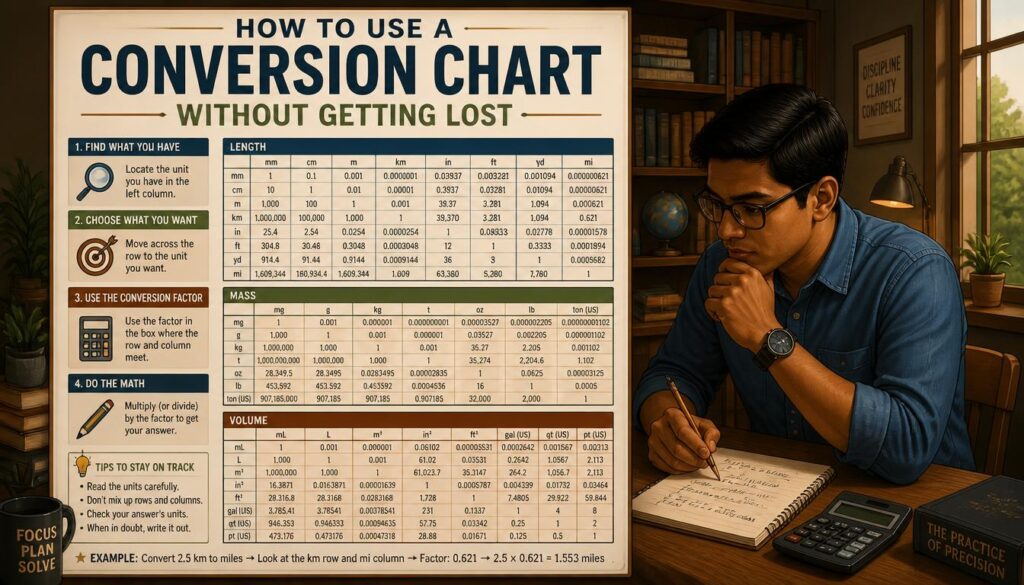
A conversion chart works best as a quick reference rather than as a replacement for understanding the underlying conversion. Start by finding the SAE fraction, check its decimal equivalent, then look at the millimeter value.
This three column approach makes fractional measurement much easier on the eyes.
You can create your own socket conversion chart or wrench conversion chart and keep it inside a toolbox. Include the SAE size, decimal inches, exact millimeters, and perhaps the nearest common metric size.
Just make sure the last column is clearly marked as “nearest,” because otherwise someone may interpret it as an exact equivalent, and that could get messy.
A practical chart might therefore say:
- 15/32″ → 0.46875″ → 11.90625 mm → nearest common metric size: 12 mm
- 1/2″ → 0.50000″ → 12.7 mm → between 12 mm and 13 mm
- 9/16″ → 0.56250″ → 14.2875 mm → between 14 mm and 15 mm
- 5/8″ → 0.62500″ → 15.875 mm → close to 16 mm
- 3/4″ → 0.75000″ → 19.05 mm → close to 19 mm
That little distinction between exact and approximate is probably the most useful part of any conversion reference, really.
Quick Answers to Common 15/32″ Questions
If you’re here because you need a fast answer rather than a grand tour of measurement history, these are the bits worth bookmarking. They’re short, but they answer the questions that usually pop up when someone has a 15/32″ marking staring back at them.
- What is 15/32 to mm? It is 11.90625 mm.
- What is 15/32 inch to mm? 15/32″ = 11.90625 mm.
- What is 15/32″ in decimal? It is 0.46875 inch.
- What is the 15/32 inch metric equivalent? The exact equivalent is 11.90625 mm.
- Is 15/32″ the same as 12 mm? No. It is approximately 12 mm, but 12 mm is slightly larger.
- What is 15/32″ as a decimal? 0.46875″.
- What is 15/32″ rounded to two decimal millimeters? 11.91 mm.
- What is the 15/32″ socket size in metric? Dimensionally it is 11.90625 mm, with 12 mm being the nearby common metric socket size.
- What is 15/32″ in mm for a wrench? The dimensional conversion remains 11.90625 mm, although tool selection depends on the actual fastener.
- Can I use a 12 mm socket for 15/32″? They are very close, but they are not identical, so use the proper size when possible.
Why Exact Conversion Still Matters
It is tempting to think that a difference of 0.09375 mm is too small to care about. Sometimes it is. Sometimes it absolutely isn’t. Precision is contextual, and that’s one of the quieter lessons hiding inside a simple 15/32 inch to mm question.
Imagine two pieces of machinery assembled with dozens of fasteners. If every measurement is treated as “close enough,” the tiny differences can accumulate in ways that are not especially friendly.
On the other hand, if you’re checking whether a random tool is roughly in the 12 mm range, insisting on eleven decimal places would be a little silly too.
Good measurement practice is therefore not about worshipping precision. It’s about choosing the right precision for the job, which sounds simple but is surprisingly valuable.
Frequently Asked Questions
15/32 in inches
15/32 inch equals 0.46875 inches in decimal form, making it slightly smaller than 1/2 inch.
15/32 to mm
To convert 15/32 inch to millimeters, multiply by 25.4. The result is 11.90625 mm, or about 11.91 mm.
15/32 in mm
15/32 inch = 11.90625 mm. For most practical measurements, this can be rounded to 11.91 mm.
what size is 15/32
15/32 is a fractional inch measurement equal to 0.46875 inches or approximately 11.91 mm.
15/32 in
15/32 in represents a measurement of 0.46875 inches. Its metric equivalent is approximately 11.91 mm.
Read This Blog:https://hynoval.com/what-time-was-it-8-hours-ago-3/
A Final Thought on SAE and Metric Measurement
The journey from 15/32″ to 11.90625 mm is really just a miniature lesson in how two measurement traditions can describe the same physical distance. One gives you a fraction of an inch, the other gives you a decimal number of millimeters.
Neither is inherently mysterious once you know the bridge between them.
Remember the essentials: 1 inch = 25.4 mm; convert a fraction to a decimal by dividing the numerator by the denominator; then multiply by 25.4. For 15/32″, that means 15 ÷ 32 = 0.46875, followed by 0.46875 × 25.4 = 11.90625 mm. If you need a quick workshop figure, 11.91 mm is usually a comfortable rounded answer.
And perhaps that’s the nicest thing about a good conversion reference: it doesn’t merely give you an answer, it gives you a way to find the answer again.
Whether you’re sorting SAE socket sizes, comparing metric socket sizes, checking wrench sizes, measuring screws, or trying to understand an old fastener, the same little conversion method keeps working.
No drama, no mysterious toolbox folklore, just a fraction, a conversion factor, and a result that finally makes sense.