

There is something slightly funny about asking how many days until summer 2026 when the calendar has already wandered deep into the season.
The lemonade is probably half gone, the sandals have seen things, and somewhere a person is already complaining that summer went by too quickly. But calendars have their own quiet logic, and Summer 2026 is still very much with us.
As of August 8, 2026, there are 0 days until summer 2026 in the Northern Hemisphere because summer has already arrived.
The astronomical season began with the summer solstice on June 21, 2026. In Pakistan Standard Time, the solstice occurred at about 1:24 p.m. on that day. Astronomically, summer will continue until the September equinox on September 23, 2026.
If you’re actually wondering how many days are left, thats a different little question. From August 8 to August 31, there are 23 days remaining in meteorological summer.
The astronomical season has about 46 calendar days left before September 23 arrives. So yes, summer is here, but it is also already packing a tiny suitcase.
How Many Days Until Summer 2026? The Short Answer
If your question is literally how many days until summer 2026, the answer depends on which definition of summer you mean.
For the Northern Hemisphere, the important dates are:
- June 1, 2026: beginning of meteorological summer.
- June 21, 2026: astronomical summer begins at the June summer solstice.
- July 2026: the second month of meteorological summer.
- August 8, 2026: the current date for this article.
- August 31, 2026: final day of meteorological summer.
- September 23, 2026: astronomical summer ends with the September equinox.
So, for someone searching for days until summer 2026, there is no future countdown anymore. The countdown has crossed the finish line, waved at us, and gone looking for an ice cream.
For people who really mean how many days until summer ends, the answer is more useful: meteorological summer has 23 days left from August 8, while astronomical summer continues into September.
When Does Summer Start in 2026?
The answer to when does summer start isn’t quite as simple as one date printed in giant red ink.
There are two common systems: the meteorological definition and the astronomical definition. Meteorologists and climatologists generally use complete calendar months because this makes climate records and seasonal comparisons much easier.
Astronomical seasons are based on equinoxes and solstices, which are connected to Earth’s position as it travels around the Sun.
Under the meteorological calendar, summer begins on June 1 in the Northern Hemisphere and ends on August 31. This gives meteorologists three neat months: June, July and August.
Under the astronomical definition, the first day of summer is the June solstice. In 2026, that occurred on June 21. The U.S. Naval Observatory lists the 2026 June solstice at 08:24 UTC, while local times vary by location.
That small disagreement is why two people can confidently give different answers to “when does summer start?” and both be correct. Calendars, bless them, do enjoy making simple questions slightly complicated.
What Is the Summer Solstice 2026?
The summer solstice 2026 was a particularly important astronomical marker because it represented the moment when the Northern Hemisphere reached its greatest tilt toward the Sun during the annual cycle.
The June solstice occurred on June 21, 2026, at 08:24 UTC. In the Northern Hemisphere, it marks the longest daylight period of the year in many locations. South of the equator, however, the same event is the winter solstice, bringing the shortest daylight period of the year.
It sounds almost poetic, but there is proper science underneath it. Earth’s axis is tilted, and as our planet moves around the Sun, that tilt changes how sunlight reaches different parts of Earth during the year.
The solstice isn’t a whole day in astronomical terms. It is a precise moment. We call the surrounding date “the solstice,” though, because saying “Happy Solstice at exactly 08:24 UTC” would make a family picnic feel unnecessarily official.
How Many Days Are in Summer 2026?
This question also depends on which calendar you’re using.
Meteorological summer in the Northern Hemisphere consists of June, July and August, giving it 92 days in a normal year such as 2026.
Astronomical summer is slightly different. The period from the June solstice to the September equinox lasts about 93 days and 15 hours in the Lahore time zone, according to the local astronomical season calculations.
Why isn’t every season exactly the same length? Because Earth does not travel around the Sun at a perfectly constant speed. Its orbit is slightly elliptical, so the lengths of astronomical seasons vary.
This is one of those facts that makes a summer countdown feel unexpectedly grand. You aren’t merely counting squares on a wall calendar. You’re counting a portion of Earth’s enormous trip around the Sun.
When Does Summer End in 2026?
The answer to when does summer end has two versions too.
For the meteorological calendar, the last day of summer is August 31, 2026. On September 1, meteorological autumn begins in the Northern Hemisphere.
For the astronomical calendar, summer ends at the September equinox. In 2026, the September equinox occurs on September 23 in Pakistan Standard Time, at approximately 5:05 a.m.
That means somebody searching when does summer end in 2026 may see either August 31 or September 23. Neither answer is automatically wrong. They simply belong to different definitions.
The September equinox marks the beginning of astronomical autumn in the Northern Hemisphere and astronomical spring in the Southern Hemisphere.
How Many Days Until Summer Ends?
As of August 8, 2026, here’s the practical countdown:
- 23 days until meteorological summer ends on August 31.
- 46 days until astronomical summer ends on September 23.
- 0 days until summer begins, because it already began earlier this year.
So if you’re planning a final beach trip, outdoor party, school holiday activity or one last ridiculous amount of watermelon, you have a little time left. Not infinite time, though. Summer never signs a contract saying it will stay.
Meteorological Summer vs. Astronomical Summer
The difference between meteorological summer and astronomical summer is worth understanding because it answers many of the confusing summer-date searches people make online.
Meteorological seasons divide the year into tidy three-month blocks. In the Northern Hemisphere, June, July and August are summer.
This system helps meteorologists and climatologists compare average temperature, precipitation and other climate measurements across consistent periods.
Astronomical seasons are tied to celestial events. Spring begins at an equinox, summer begins at a solstice, autumn begins at an equinox and winter begins at a solstice.
Neither system is trying to defeat the other. They answer different questions.
If you’re checking climate statistics, meteorological summer is usually the cleaner tool. If you’re asking about Earth’s relationship with the Sun, astronomical summer is the more meaningful definition.
So when somebody says, “Summer starts June 1,” and somebody else says, “No, it’s June 21,” there doesn’t need to be a dramatic family argument. Both calendars have receipts.
Summer in the Northern Hemisphere and Southern Hemisphere
The Northern Hemisphere and Southern Hemisphere experience opposite astronomical seasons.
In the Northern Hemisphere, summer is associated with the June solstice and generally runs from June into September under the astronomical definition. In the Southern Hemisphere, the December solstice marks the beginning of astronomical summer.
That gives us two broad seasonal patterns:
Northern Hemisphere summer
- June
- July
- August
- September, under the astronomical definition
Southern Hemisphere summer
- December
- January
- February
- March, under the astronomical definition
So while someone in Canada may be hunting for shade in July, someone in Australia may be reaching for a jumper. The same Earth is doing its yearly dance, just with opposite hemispheres facing the seasonal music.
The Southern Hemisphere’s astronomical summer begins around the December solstice, which in 2026 occurs on December 21 UTC.
Summer Dates for 2027, 2028, 2029 and 2030
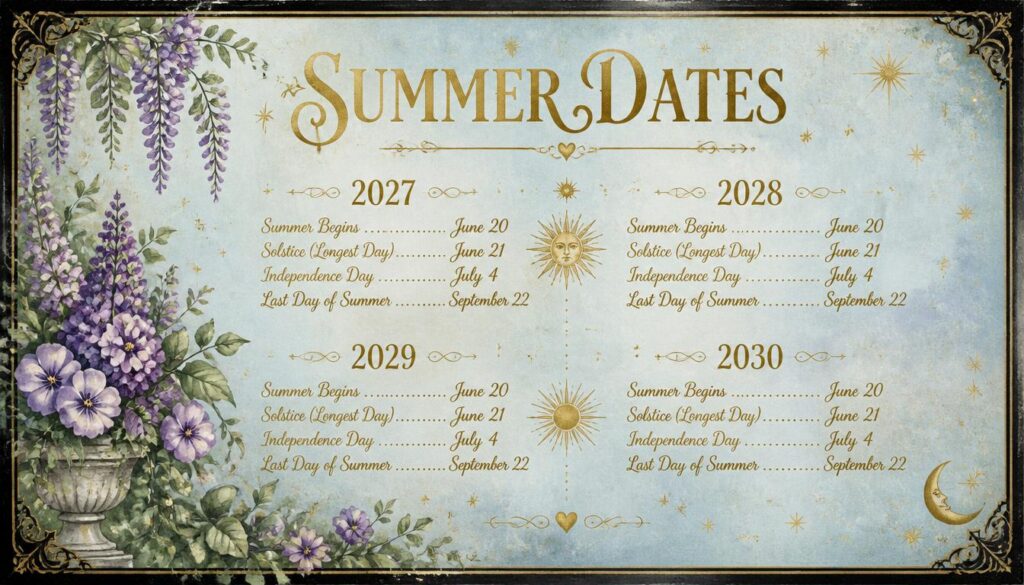
If you’re not interested in only Summer 2026, looking ahead can be handy for school planning, travel, weddings, holidays or those ambitious “next summer will be different” promises we make to ourselves.
Here are the astronomical summer dates for the Northern Hemisphere:
| Year | Summer begins | Summer ends |
|---|---|---|
| Summer 2026 | June 21, 2026 | September 23, 2026 |
| Summer 2027 | June 21, 2027 | September 23, 2027 |
| Summer 2028 | June 20, 2028 | September 22, 2028 |
| Summer 2029 | June 21, 2029 | September 22, 2029 |
| Summer 2030 | June 21, 2030 | September 23, 2030 |
The dates can shift by a day because the astronomical events occur at precise moments, while our civil calendar divides time into whole dates and time zones can place an event on different local days. The listed local seasonal calculations show these variations across the years.
Notice June 20, 2028 sitting there looking a little rebellious. That’s not a typo. Solstices can occur on June 20, June 21 or, much more rarely, June 22 depending on the year and time zone.
How to Calculate Days Until Summer
If you want to calculate days until summer yourself, the basic idea is pleasantly simple.
First, identify today’s current date. Then choose your target date, such as June 21 for astronomical summer or June 1 for meteorological summer. Finally, subtract the current date from the target specific date.
For example:
Target date Current date = Days remaining
If today’s date is before June 21, the result gives you the number of calendar days until astronomical summer begins.
If today’s date is after June 21, the result becomes negative, which is spreadsheet language for “Mate, summer is already here.”
For a simple summer countdown, you should also decide whether you want to count the current day.
Most date difference calculations do not count the starting date as a completed day. This tiny detail can make two countdowns differ by one, which is why checking the method matters.
How to Calculate Days Until Summer in Excel
You can create a basic summer countdown in Excel without turning your spreadsheet into a monster.
Suppose cell A1 contains today’s date. You could enter:
=DATE(2026,6,21)-A1
That calculates the difference between the target date, June 21, 2026, and the date stored in A1.
But if you want Microsoft Excel to automatically use today’s date, you can use:
=DATE(2026,6,21)-TODAY()
Here, TODAY() returns the current date, while DATE() constructs the target date.
For example, if you’re creating a countdown before summer begins, the formula gives the number of days remaining. Once June 21 passes, the result becomes negative.
You can also make a more flexible spreadsheet by placing the target date in another cell. If A1 contains the current date and B1 contains the summer start date, simply use:
=B1-A1
That approach is useful if you want to reuse the sheet for Summer 2027, Summer 2028, Summer 2029 or Summer 2030 without rewriting the formula every year.
Google Sheets Summer Countdown
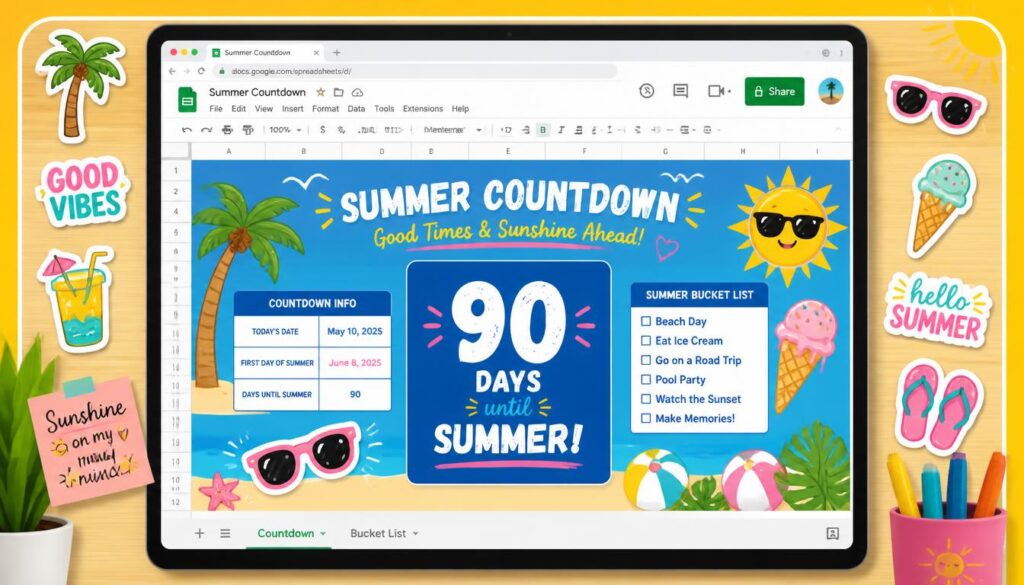
The same general idea works in Google Sheets.
You can enter:
=DATE(2026,6,21)-TODAY()
and Google Sheets will calculate the number of days between today’s date and June 21, 2026.
For a reusable Google Sheets summer countdown, put the target date into a separate cell and subtract today’s date from it. This is cleaner than hard-coding dates everywhere, especially if your spreadsheet grows into one of those beautiful little projects that somehow has 19 tabs.
You can also calculate the difference between two dates using straightforward date subtraction:
=B1-A1
where B1 is the target date and A1 is the starting date.
The important thing isn’t the software. Microsoft Excel, Google Sheets and other spreadsheet software all work from the same underlying idea: identify two dates and calculate the difference between them.
What Causes the Seasons?
The seasons aren’t caused simply by Earth getting closer to or farther from the Sun.
The major reason is Earth’s axial tilt. As Earth travels around the Sun, the tilt changes the angle and duration of sunlight received by each hemisphere.
During the June solstice, the Northern Hemisphere is tilted toward the Sun, producing longer daylight and more direct sunlight there. At the same time, the Southern Hemisphere experiences winter conditions associated with the opposite seasonal arrangement.
This is why the summer solstice Northern Hemisphere and the summer solstice Southern Hemisphere don’t happen at the same time of year. In fact, the December solstice is summer in the south and winter in the north.
It sounds simple when you say it quickly. Earth’s orbital geometry, however, is doing a fairly spectacular amount of work behind that one sentence.
Why Summer Can Feel Longer Than the Calendar Says
There is a charming contradiction in summer: the astronomical season may have a precise beginning and ending, but weather does not read calendars.
A hot day can arrive before June 1. A cool afternoon can appear in August. Some places remain warm well into September, while other regions begin feeling autumn much earlier.
Climate patterns, ocean temperatures, altitude, latitude and local geography all influence how a season feels. NOAA notes that the warmest part of the year can vary considerably by location rather than landing on one universal date.
That is why season of warmth is more of a human description than a scientific stopwatch.
Summer is partly a date on a calendar, partly an astronomical event, and partly that unmistakable feeling when evening refuses to become evening.
Summer Countdown Ideas for Families and Friends
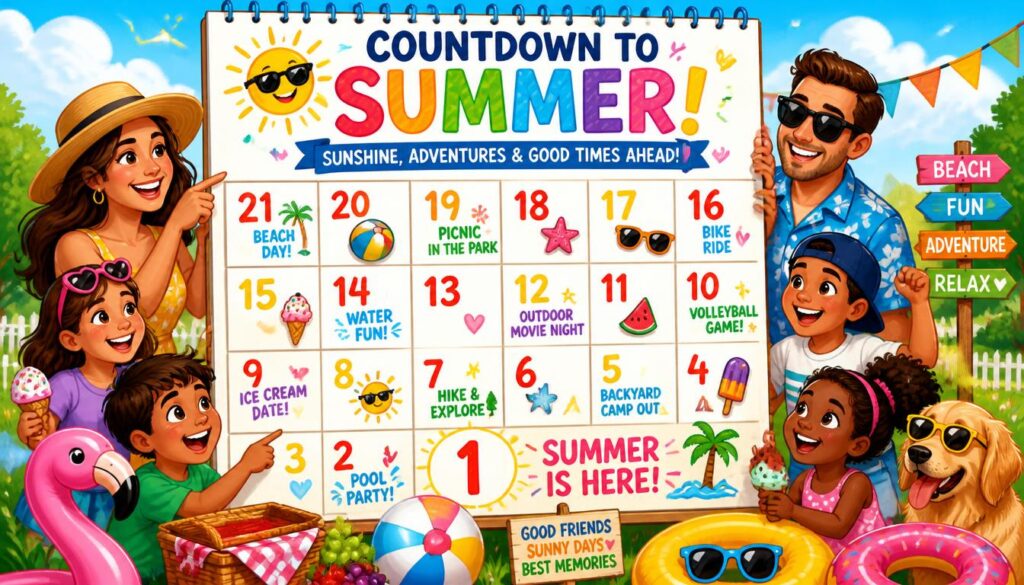
A countdown doesn’t have to live only on a website or spreadsheet.
You can make the final stretch of Summer 2026 into something memorable with small rituals that don’t require a grand holiday budget. Write down one thing you enjoyed each week.
Take photographs of ordinary evenings. Make a playlist for the season. Have a picnic just before meteorological summer ends.
For families, a “last 10 summer days” jar can be surprisingly lovely. Put tiny ideas on folded pieces of paper: watch the sunset, make homemade lemonade, eat breakfast outside, visit a park, call a relative, take a silly photograph, or simply do absolutely nothing for an hour.
For friends, the countdown can become an excuse rather than an obligation. The best summer memories are often made from plans that sounded slightly ridiculous at first.
And if you’re already looking toward Summer 2027, don’t make the mistake of believing you need a perfect plan. A season doesn’t become meaningful because every weekend is booked. Sometimes the unplanned Tuesday is the story everyone remembers.
Summer Dates Around the World
Seasonal dates can look surprisingly different depending on where you live.
In the Northern Hemisphere, the astronomical sequence is spring, summer, autumn and winter as the year moves from the March equinox through the June solstice, September equinox and December solstice.
In the Southern Hemisphere, those seasonal labels reverse. The December solstice begins astronomical summer there, while the June solstice marks winter.
This is why a global summer calendar should never assume that “summer” means June, July and August for everybody.
A person searching from Sydney, Cape Town or parts of South America may be thinking about December, January and February when they say summer. Someone in the Northern Hemisphere is more likely thinking about June through August.
Same planet. Different side of the seasonal seesaw.
A Simple Summer 2026 Countdown Calendar
If you want an easy reference point, keep these dates nearby:
- June 1, 2026: meteorological summer begins in the Northern Hemisphere.
- June 21, 2026: astronomical summer begins with the summer solstice.
- July 2026: first full calendar month after the solstice.
- August 8, 2026: current date used for this article.
- August 31, 2026: meteorological summer ends.
- September 23, 2026: astronomical summer ends at the September equinox.
- December 21, 2026: December solstice, beginning astronomical summer in the Southern Hemisphere.
If you’re searching for what day does summer start 2026, use June 1 for the meteorological definition or June 21 for the astronomical definition.
If you’re searching for what day does summer end 2026, use August 31 for meteorological summer or September 23 for astronomical summer.
Once you know which definition you need, the confusion disappears rather quickly.
Frequently Asked Questions About Summer 2026
How many days until summer 2026?
As of August 8, 2026, there are 0 days until summer 2026 in the Northern Hemisphere because it has already begun. Meteorological summer started June 1, while astronomical summer began June 21.
When is the summer solstice in 2026?
The summer solstice 2026 occurred on June 21. The exact astronomical moment was 08:24 UTC. Local clock dates and times depend on the time zone.
What is the first day of summer 2026?
There are two common answers. June 1, 2026 is the first day of meteorological summer. June 21, 2026 is the first day of astronomical summer in the Northern Hemisphere.
What is the last day of summer 2026?
Meteorological summer ends on August 31, 2026. Astronomical summer ends on September 23, 2026, with the September equinox.
How long is summer 2026?
Meteorological summer lasts 92 calendar days in the Northern Hemisphere in 2026. Astronomical summer is slightly longer than 93 days, ending at the September equinox.
When does meteorological summer begin?
In the Northern Hemisphere, meteorological summer begins June 1 and ends August 31. This fixed-month system is used for many climate and weather statistics.
When does summer start in the Southern Hemisphere?
Astronomical summer in the Southern Hemisphere begins around the December solstice. In 2026, that solstice occurs on December 21 UTC.
Why do summer dates change from year to year?
The dates of equinoxes and solstices vary because Earth’s orbital period doesn’t fit perfectly into our 365-day calendar. Leap years help keep the calendar aligned with the astronomical seasons.
Make Your Summer Countdown More Personal
A countdown becomes much more enjoyable when it measures something you actually care about.
Instead of writing “42 days until summer,” try “42 days until our first evening picnic,” or “42 days until the school holidays,” or even “42 days until I finally clean the balcony.” The number becomes attached to a real-life event, and suddenly it has a little heartbeat.
If you’re planning for Summer 2027, choose one date and work backward. A specific target is easier to plan around than a vague promise to “do more fun things.”
You can use a wall calendar, phone reminder, Excel sheet, Google Sheets tracker or a handwritten notebook. The method matters less than the intention.
And don’t be afraid to leave blank days. A summer calendar packed from sunrise to bedtime may look impressive, but an empty afternoon can sometimes be the best square on the page.
Frequently Asked Questions
how many days until summer 2026
Summer 2026 began on June 21, 2026, so it has already started. There are 0 days left until summer 2026.
how many days until the first day of summer
The first day of summer 2026 was June 21, 2026. It has already passed, so the countdown is 0 days.
how many days till summer 2026
Summer 2026 started on June 21, 2026. As of August 8, 2026, summer is already underway.
how many day until summer
If you mean summer 2026, it already began on June 21, 2026. There are 0 days remaining until its start.
how much days till summer
Summer 2026 has already arrived, beginning on June 21. So, there are 0 days left until summer 2026.
Read this Blog:https://hynoval.com/weeks-ago-calculator/
Final Thoughts: Summer Is a Date, But It Is Also a Feeling
So, how many days until summer 2026? As of August 8, the answer is zero. Summer has already arrived, crossed the threshold, and settled into the room.
There are still 23 days until the end of meteorological summer, and roughly 46 calendar days until astronomical summer ends on September 23.
But perhaps the more interesting question isn’t how many days remain. It is what we choose to do with the days that remain.
The summer solstice gives us a precise astronomical moment, yet summer itself refuses to stay neatly inside a box.
It can be a June morning, a July storm, an August evening, a childhood memory, a road trip, a glass of something cold, or simply the strange happiness of realizing the sun is still hanging around when you thought the day should be finished.
For the Northern Hemisphere, summer 2026 will eventually give way to autumn. The Southern Hemisphere will move toward its own summer as December approaches.
Then Summer 2027, Summer 2028, Summer 2029 and Summer 2030 will arrive in their own slightly different astronomical rhythm.
That’s the lovely part of a seasonal calendar: it keeps moving, whether we’re ready or not.
So enjoy the remaining stretch of Summer 2026. Take the photograph. Sit outside a little longer. Make the unnecessary trip for ice cream. Watch the evening light disappear.
And if you have a favorite summer memory, share it with someone. Calendars can tell us when a season begins, but people are the ones who give that season a story.