


Time has a funny habit of slipping through our fingers. One Friday you are checking a calendar, and somehow another month has wandered off without saying goodbye. When someone asks, “What date was 12 weeks ago?”
it sounds like a tiny question, but counting backwards through a calendar can become surprisingly annoying.
That is where a Weeks Ago Calculator earns its keep.
A weeks-ago calculator is a simple date calculator designed to answer one particular kind of question: given a starting date, usually today, what calendar date occurred a certain number of weeks in the past?
Instead of manually turning calendar pages or counting little boxes with your finger, you enter the number of weeks and let the calculation do its quiet little job.
For example, if the reference date is Friday, August 7, 2026, then 1 week ago was Friday, July 31, 2026. Ten weeks ago was Friday, May 29, 2026.
The interesting part is that the weekday stays the same when you move backward by complete weeks, because every week contains exactly seven days.
This guide explains what the calculator actually does, how to calculate weeks ago, why the weekday remains consistent, and how you can use a past date calculator for everything from school assignments and project records to anniversaries, appointments, deadlines, and historical date checks.
What Is a Weeks Ago Calculator?
A Weeks Ago Calculator is essentially a calendar tool that moves a date backward by a specified number of seven-day periods. It sounds almost too simple, and technically the arithmetic is simple, but the usefulness comes from making that arithmetic instant and less error-prone.
Suppose you want to know the date 6 weeks ago. You could count backward six rows on a calendar, although calendars don’t always behave nicely when months change. A calculator instead converts the six weeks into days:
6 weeks × 7 days = 42 days
It then subtracts those 42 days from the starting date.
So, if the starting date is August 7, 2026, six weeks earlier is June 26, 2026. No mysterious calendar magic happened there; the calculator simply moved the date backward by 42 days.
The same idea works whether you want 5 weeks ago, 20 weeks ago, or even 100 weeks ago. The input changes, but the underlying calculation remains pleasantly boring which is exactly what you want from a calculator.
A useful tool may also show information beyond the resulting date, such as the day of the week, week number, or day number within the year. That extra information can be handy when the question is more specific than simply “what date was it?”
How the Weeks Ago Calculator Works
The basic calculation is built around one uncomplicated fact: 1 week = 7 days.
If you know the number of weeks you want to travel backward, multiply that number by seven. The resulting number is the number of days to subtract from your starting date.
For instance:
- 1 week = 7 days
- 5 weeks = 35 days
- 9 weeks = 63 days
- 12 weeks = 84 days
- 14 weeks = 98 days
- 20 weeks = 140 days
- 36 weeks = 252 days
- 68 weeks = 476 days
- 100 weeks = 700 days
So the general idea is very straightforward:
Past date = reference date − (number of weeks × 7 days)
If your reference date is August 7, 2026, and you want to know what date was 20 weeks ago, you subtract 140 days. The answer is March 20, 2026.
The calculator handles the awkward part, which is crossing between months with different lengths. February, April, June, September, November — they all have their own little calendar personalities, and manual counting can go wrong pretty easily.
A proper calendar calculator knows those month lengths and accounts for leap years too. You don’t have to remember whether February had 28 or 29 days in the year you are investigating, which is probably a good thing because there are more interesting things to remember.
Weeks Ago Calculator From Today
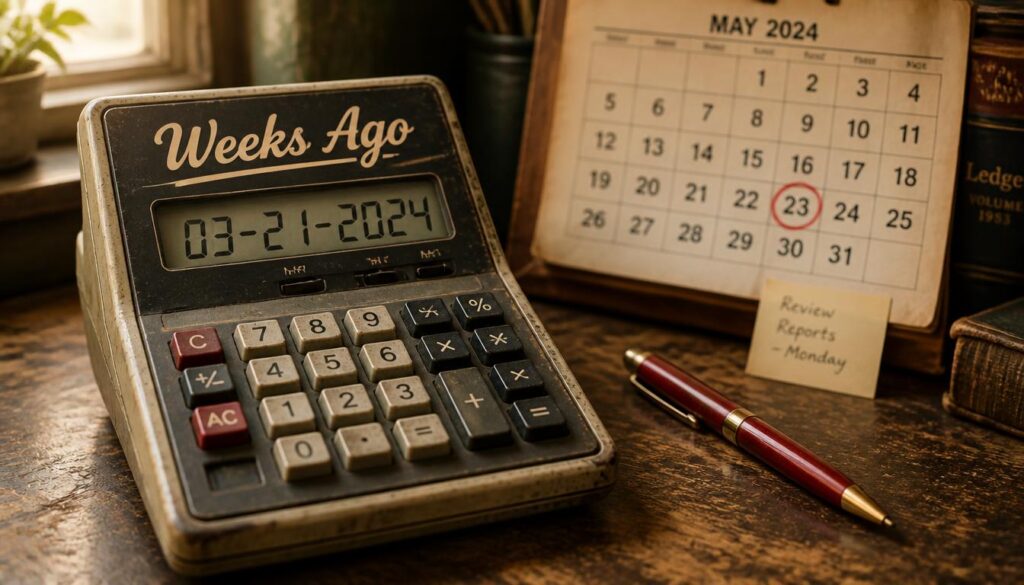
When people search for a weeks ago calculator from today, they usually have one simple intention: they want to find a past date without choosing a separate starting date.
In this situation, today becomes the reference date.
For example, using Friday, August 7, 2026 as the current date:
- 1 week ago → Friday, July 31, 2026
- 5 weeks ago → Friday, July 3, 2026
- 6 weeks ago → Friday, June 26, 2026
- 9 weeks ago → Friday, June 5, 2026
- 12 weeks ago → Friday, May 15, 2026
- 14 weeks ago → Friday, May 1, 2026
- 20 weeks ago → Friday, March 20, 2026
- 36 weeks ago → Friday, November 28, 2025
- 68 weeks ago → Friday, April 25, 2025
- 100 weeks ago → Friday, September 6, 2024
Notice something rather neat here: every result is a Friday. That isn’t coincidence. If you subtract a whole number of weeks, you subtract a whole number of seven day cycles, so the day of the week does not change.
This is one of the easiest ways to perform a quick sanity check. If today is Friday and a result claiming to be exactly 20 weeks ago says Tuesday, something has gone sideways somewhere.
Of course, the reference date matters. A calculation performed on a different day will produce a different answer. That’s why a reliable calculator should clearly identify its current date or allow you to enter a custom reference date.
Why Does One Week Always Mean Seven Days?
The answer seems obvious, but it is the foundation of the entire calculation.
A calendar week contains seven days: Monday through Sunday in the common international convention. When you move backward exactly seven days, you arrive on the same weekday.
Move backward 14 days and you have gone through two complete weeks. Move backward 70 days and you have gone through ten.
This means:
Number of weeks × 7 = number of days
It also means that weeks from today and weeks ago from today can be treated as mirror-image calculations.
If you are calculating into the past, subtract the appropriate number of days. If you are calculating into the future, add them.
For example, 8 weeks ago means subtract 56 days. Eight weeks from today means add 56 days. Same arithmetic, opposite direction. The calendar, thankfully, doesn’t demand a completely new set of rules just because you are looking forward instead of backward.
What Information Can a Date Calculator Show?
A basic date calculator may return only the final calendar date. More advanced tools can provide several useful pieces of information.
Exact Calendar Date
This is usually the main answer. If you enter a reference date and a number of weeks, the calculator identifies the precise date reached after moving backward.
For historical records, deadlines, and planning, this is generally the information people care about most.
Day of the Week
The day of the week tells you whether the resulting date was a Monday, Tuesday, Wednesday, and so on.
With whole-week calculations, the weekday will match the starting date. If August 7, 2026 is a Friday, then 5 weeks ago, 20 weeks ago, and 100 weeks ago are also Fridays.
Week Number
Some calculators identify the week number of the year, often using the ISO week-numbering system.
This can be useful in workplaces, schools, manufacturing schedules, project management, and reporting systems where dates are discussed as “Week 32” or “Week 41” rather than by month and day.
The exact week-number convention can matter, though, so don’t assume every calendar system labels weeks identically.
Day Number of the Year
A calculator may also show the day number within the year. For example, a date in January will have a low day-of-year number, while a date late in December will have a much larger one.
This isn’t needed for an ordinary “what date was 12 weeks ago?” question, but it can be useful for data analysis or technical applications.
Real Life Reasons to Calculate Weeks Ago
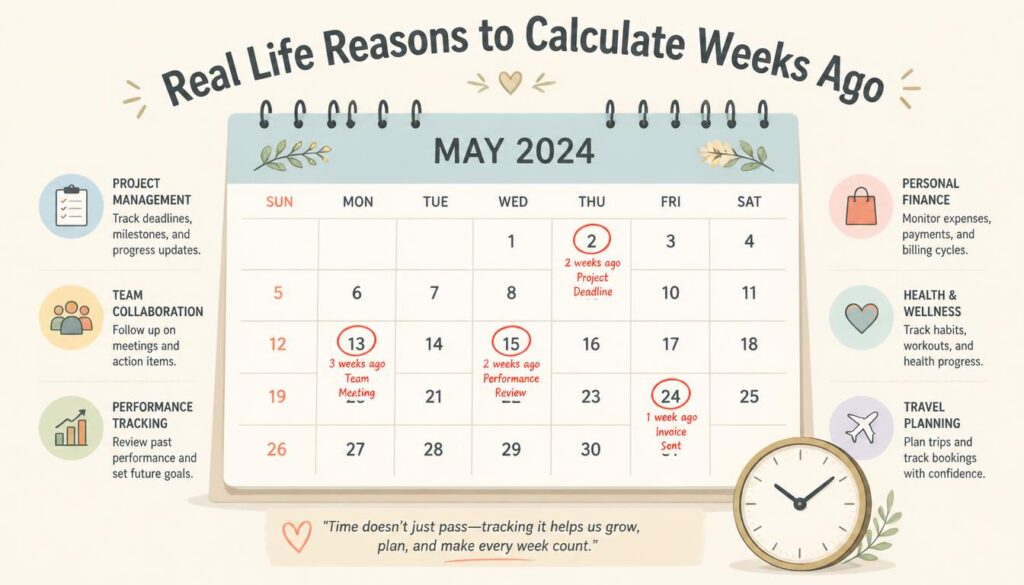
People rarely wake up thinking, “Today I shall subtract 147 days from a calendar date.” Usually there is a reason hiding behind the question.
A past date calculator can be useful in everyday situations such as these:
- Tracking pregnancy or medical appointment schedules: People may need to identify a date several weeks before a current appointment, though medical timelines should always be checked against professional guidance.
- School and university work: Students sometimes need to determine when a project, class, or event occurred.
- Work projects: A manager may want to know which date fell 8 or 12 weeks before a reporting deadline.
- Fitness programs: Training plans often refer to weeks completed rather than individual dates.
- Financial records: A person may need to identify when a transaction or event occurred relative to a current date.
- Event planning: Organizers may check how many weeks have passed since registration, booking, or an earlier event.
- Personal memories: Sometimes you simply remember something happened “about nine weeks ago” and want to discover the actual date.
- Research: Historical or archival work can involve moving backward by fixed weekly intervals.
- Content planning: Bloggers, marketers, and social media managers may compare activity from a certain number of weeks earlier.
- Project retrospectives: Teams can use previous dates to understand when a milestone, problem, or decision happened.
The last one is particularly useful. Human memory is not a spreadsheet. We remember “around spring” or “a few weeks before Eid” or “somewhere after the big meeting.” A date calculator helps turn those fuzzy memories into something concrete.
How to Calculate Weeks Ago Manually
You don’t actually need an online tool if you have a calendar and a little patience.
Start with your reference date. Then multiply the number of weeks by seven.
Imagine the question is: “What date was 12 weeks ago from August 7, 2026?”
First:
12 × 7 = 84 days
Then subtract 84 days from August 7, 2026. The resulting date is May 15, 2026.
You can also count week-by-week, but this becomes irritating once the number gets large. Counting 100 weeks means moving backward 700 days, and at that point an online week calculator starts looking like a very sensible friend.
Manual calculations can also become tricky around leap years. A leap year adds an extra day to February, which matters when the calculation crosses that part of the calendar.
For that reason, a calculator is generally preferable when accuracy matters. The arithmetic itself is easy; keeping every calendar detail straight is the slightly sneaky part.
Weeks Ago Calculator Examples for Different Time Intervals
Different numbers of weeks can represent surprisingly different periods.
5 Weeks Ago
Five weeks equals 35 days. From August 7, 2026, that brings us to July 3, 2026.
This interval is useful when someone wants to check a recent event that happened a little more than one month ago.
9 Weeks Ago
Nine weeks equals 63 days. From August 7, 2026, the result is June 5, 2026.
Nine weeks is long enough that manually remembering the exact date can get slippery, especially if several other events happened in between.
14 Weeks Ago
Fourteen weeks equals 98 days. The date is May 1, 2026.
This is a good example of why saying “about three months ago” isn’t always precise. Three calendar months and fourteen weeks aren’t necessarily the same period.
36 Weeks Ago
Thirty-six weeks equals 252 days. From August 7, 2026, the answer is November 28, 2025.
At this distance, a calendar tool becomes especially helpful because you are crossing a year boundary.
100 Weeks Ago
One hundred weeks equals 700 days. From August 7, 2026, the result is September 6, 2024.
This is a useful reminder that “weeks” and “months” are not interchangeable. One hundred weeks is substantially more than 20 months, but it doesn’t line up perfectly with a simple month count either.
Weeks and Months Are Not the Same Thing
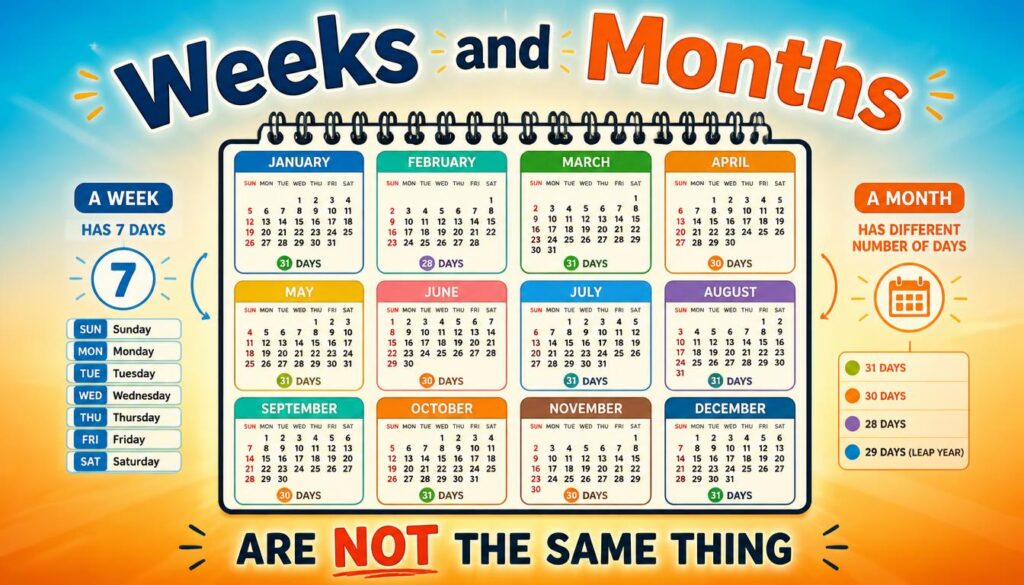
One common mistake is treating four weeks as exactly one month.
Four weeks equals 28 days. But calendar months can contain 28, 29, 30, or 31 days.
That tiny difference becomes important over time.
For example, if somebody says an event happened “three months ago,” they may mean the same calendar day three months earlier. If they say it happened “12 weeks ago,” they mean exactly 84 days earlier.
Those can produce different dates.
This is why a date difference calculator should use the unit the question actually specifies. If the question is about weeks, calculate weeks. If it is about calendar months, calculate months. Mixing the two can create a result that looks reasonable while quietly being wrong.
And those are the annoying mistakes the ones that look perfectly respectable.
Weeks Ago Versus Days Ago
A days ago calculator works on the same basic principle, except the unit is already days.
If someone asks what date was 42 days ago, that is exactly the same as asking what date was 6 weeks ago because:
6 × 7 = 42
The difference is mainly in how people describe time.
Someone might say, “I started this course six weeks ago,” while a record system might say, “The event occurred 42 days before the reference date.”
Neither is wrong. They simply package the same interval differently.
For ordinary human communication, weeks are often easier to understand. For precise calculations, days can sometimes be more convenient.
Can You Calculate Weeks Ago From Any Date?
Yes. A good online date calculator doesn’t have to use today as the starting point.
You can choose a custom reference date.
Suppose you want to know what date was 20 weeks before January 1, 2026. You would enter January 1, 2026 as the starting date and 20 as the number of weeks.
The same approach works for historical dates, future dates, birthdays, contracts, project milestones, and other calendar events.
This is particularly valuable when researching older records. “What was 12 weeks before this date?” is not really a “today” question at all. It’s a reference-date question.
Thinking of it this way makes the tool much more flexible.
Common Mistakes When Calculating a Past Date

Even simple calendar calculations can go wrong. A few mistakes appear again and again.
Counting calendar boxes instead of seven-day intervals: Crossing from one month to another can make visual counting unreliable.
Treating a month as four weeks: Four weeks is 28 days, not a universal month.
Forgetting leap years: February sometimes contains 29 days, and that can affect calculations crossing February.
Using the wrong starting date: A result is only as accurate as the reference date you give the calculator.
Confusing “weeks ago” with “days ago”: The units describe different inputs unless you convert them properly.
Assuming every week-number system is identical: ISO week numbers and other calendar conventions can differ around the beginning and end of a year.
Rounding the answer: A date calculation should normally produce an exact calendar date rather than “roughly sometime in May.”
The safest habit is simple: identify the reference date, identify the exact number of weeks, calculate in seven-day intervals, and then verify the resulting weekday.
How to Use a Weeks Ago Calculator Correctly
Using a Weeks Ago Calculator is generally a three-step process.
First, identify your starting date. If the question says “from today,” use today’s date. If it gives a specific date, use that date instead.
Second, enter the number of weeks. For example, if you want to know what date was 14 weeks ago, enter 14.
Third, read the calculation result. Depending on the tool, this might include the exact date, weekday, week number, and day-of-year information.
For a quick check, remember that 14 weeks is 98 days. If the calculator produces a result that is roughly three months earlier, that makes sense. If it lands somewhere only two weeks earlier, well, the calendar has clearly had a little accident.
Why Exact Dates Matter More Than “About X Weeks”
In casual conversation, estimates are fine.
“I think that happened about six weeks ago.”
But estimates become less useful when a deadline, record, contract, appointment, or research project depends on the exact date.
The phrase how many weeks ago may sound approximate, but a calculator can turn it into a precise historical date.
That precision can help people compare events, establish timelines, verify memories, and understand how much time has actually passed.
It also removes the strange psychological effect where a month feels short when you are busy and enormous when you are waiting for something. Numbers have no such mood swings.
A Quick Reference for Common Week Calculations
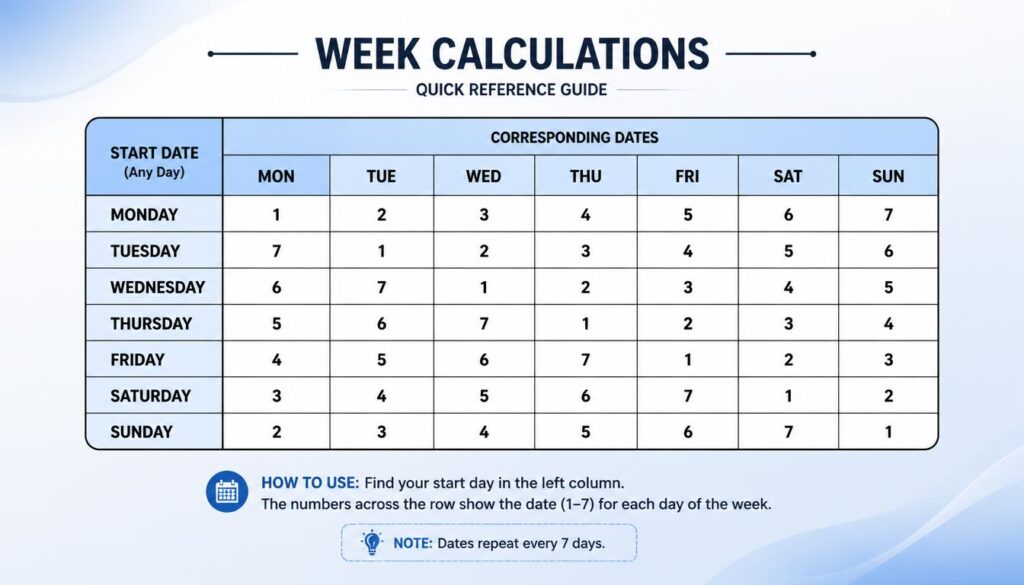
If you are working from Friday, August 7, 2026, these examples provide a handy reference:
- 1 week ago: July 31, 2026
- 5 weeks ago: July 3, 2026
- 6 weeks ago: June 26, 2026
- 9 weeks ago: June 5, 2026
- 12 weeks ago: May 15, 2026
- 14 weeks ago: May 1, 2026
- 20 weeks ago: March 20, 2026
- 36 weeks ago: November 28, 2025
- 68 weeks ago: April 25, 2025
- 100 weeks ago: September 6, 2024
Every result falls on a Friday because each calculation moves backward by a whole number of seven-day cycles.
These examples also show why a date lookup tool can be useful when the interval becomes larger. At 1 or 2 weeks, most people can count backward without much trouble. At 68 or 100 weeks, the brain quite reasonably starts asking for administrative assistance.
When a Weeks Ago Calculator Is Better Than Mental Math
Mental math is excellent for small intervals.
One week ago? Easy.
Three weeks ago? Still easy.
Seven weeks ago? Probably manageable.
But once you begin crossing multiple months, leap years, or calendar years, a dedicated calendar date calculator becomes more attractive.
The calculator doesn’t get distracted. It doesn’t accidentally skip February 29. It doesn’t lose its place while crossing from December into January. And it certainly doesn’t stop halfway through to wonder what it was doing.
For anything that needs to be recorded or shared with another person, using an exact tool is generally better than relying on an approximate memory.
How to Make Your Own Date Calculation More Reliable
If you ever need to perform the calculation manually, write down the reference date first.
Then write the number of weeks.
Multiply the number by seven.
Finally, subtract that number of days from the starting date.
Don’t rush the month transitions. If you are crossing February, check whether the relevant year is a leap year. If you are crossing December, make sure the year changes correctly.
And after you have your answer, check the weekday.
For whole-week subtraction, the weekday should be identical to the weekday of your starting date. It’s a wonderfully simple little verification trick.
Frequently Asked Questions
36 weeks ago
36 weeks ago was December 5, 2025.
when was 30 weeks ago
30 weeks ago was January 16, 2026.
9 weeks ago from today
9 weeks ago from today was June 5, 2026.
when was 23 weeks ago
23 weeks ago was February 27, 2026.
when was 11 weeks ago
11 weeks ago was May 22, 2026.
Read this Blog:https://hynoval.com/6-weeks-from-today/
Final Thoughts on the Weeks Ago Calculator
A Weeks Ago Calculator solves a small problem, but small problems are often the ones that waste the most time. Nobody wants to spend ten minutes counting backward through a calendar just to answer a question that should take ten seconds.
The core idea is refreshingly simple: take the number of weeks, multiply it by seven, and subtract those days from the reference date. The result is the exact past date you were looking for.
From 5 weeks ago to 100 weeks ago, the same principle holds. A reliable calculator can turn the calculation into an immediate answer while also giving useful details such as the day of the week, week number, or day number.
The bigger lesson is that dates are more precise than our memories usually are. “A few weeks ago” can mean different things to different people. A calendar date cannot really afford that kind of vagueness.
So when you need to find out what date was X weeks ago, whether X is 1, 12, 36, or 100, start with the correct reference date and let the calendar do its little bit of arithmetic. Your future self or perhaps the person checking your paperwork will probably appreciate the precision.
And if you have ever had a surprisingly difficult time figuring out a date that was “only a few weeks ago,” don’t worry. Calendars look innocent, but crossing three months and one February is enough to make even very confident people start counting on their fingers.