

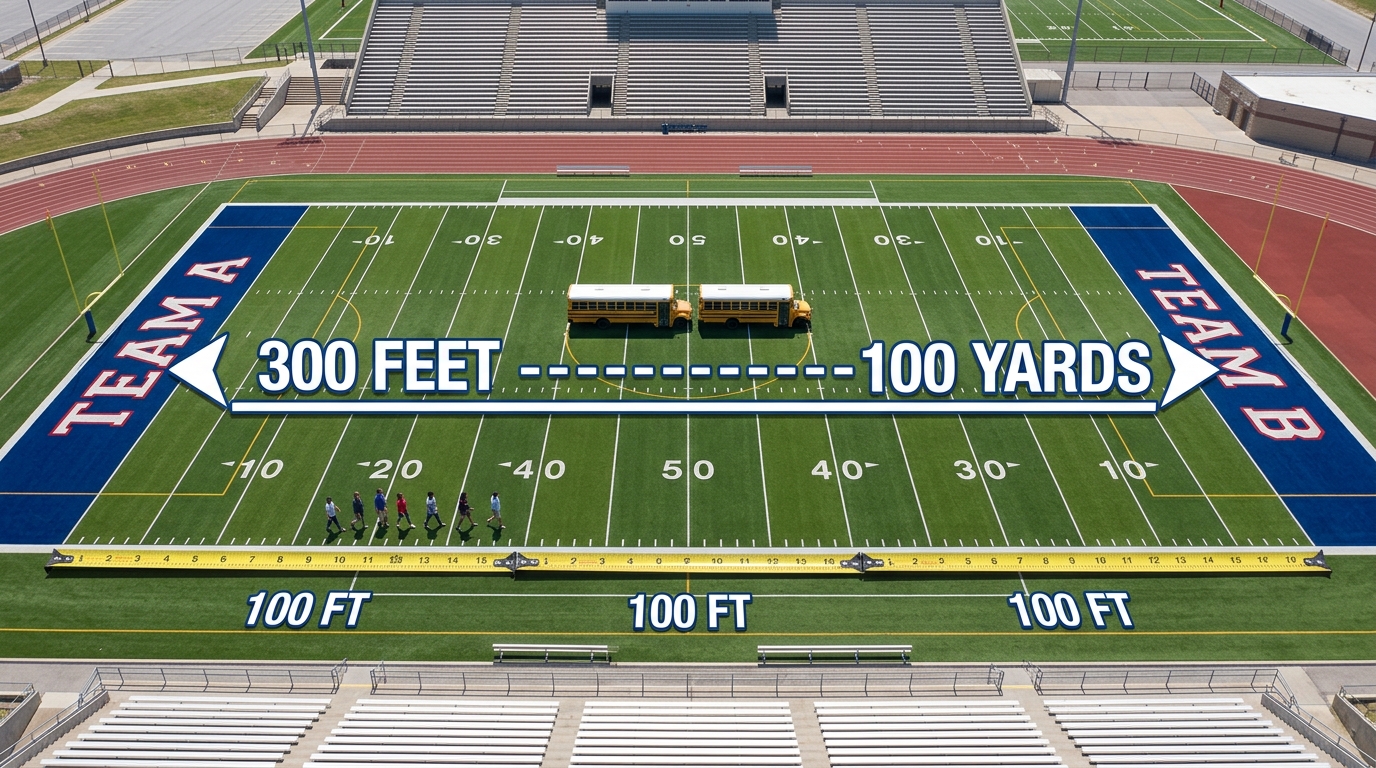
Have you ever heard someone say something is 300 feet away and tried to picture it? The number sounds clear, but our brains are kinda funny with measurements.
We can understand a small distance like 10 feet because we live inside that scale every day, but when a number reaches hundreds of feet, the picture gets blurry. A distance or length measurement like 300 feet becomes more like a mystery than a real thing we can see.
The question how long is 300 feet is actually a question about imagination as much as mathematics. Numbers tell us the amount, but comparisons tell us the story.
A person may not instantly understand 300 ft, but they might understand that it is close to the height of famous landmarks, almost a football field, or a distance that takes a comfortable walk to cross.
Those examples make the measurement feel alive, not just like a boring number written on paper.
In this guide, we will explore 300 feet visualized through buildings, sports fields, natural wonders, vehicles, and everyday experiences.
By the end, you should have a strong sense of what does 300 feet look like in real life and why human beings often need familiar objects to understand large measurements.
| Measurement | 300 Feet Equivalent |
|---|---|
| Feet | 300 ft |
| Meters | 91.44 m |
| Yards | 100 yd |
| Inches | 3,600 in |
| Centimeters | 9,144 cm |
| Millimeters | 91,440 mm |
| Approx. Football Field | Nearly the length of a football field (300 ft) |
| Approx. Adult Steps | 120 steps |
How Long Is 300 Feet? Understanding the Basic Measurement
First, let’s break down the math. A foot is an imperial measurement unit commonly used in countries like the United States for measuring height, construction, and everyday distances.
When we talk about 300 feet measurement, we are talking about a distance equal to 300 individual units of 12 inches each.
The most simple conversion is that 300 feet equals 100 yards. This is because one yard contains three feet. So, the feet to yards conversion is easy:
300 feet ÷ 3 = 100 yards
That means 300 feet distance is exactly 100 yards long. For people familiar with sports, this number suddenly feels more understandable because yards are used constantly in football and other activities.
If we convert it into metric units, 300 feet is approximately 91.44 meters. It is not a perfect match for a 100-meter track sprint, but it gets pretty close. A person standing at one end of this distance may appear quite small from the other side, especially in an open area.
The funny thing about measurements is that the number itself does not create a mental picture. A child might hear “300 feet” and imagine something enormous, while a construction worker may see it as a normal project dimension. Perspective changes everything, honestly.
How Far Is 300 Feet Visually Explained Through Everyday Life
When people ask how far is 300 feet visually, they are usually searching for a familiar comparison. Numbers need a friend, and everyday objects are that friend.
Imagine standing at one end of a straight path that is 300 feet long. Walking normally, many people could cover that distance in around one minute.
It is not a huge journey, but it is far enough that you would notice the effort. You might cross a parking lot, walk past several houses, or move through a large open space.
A few examples of 300 feet in real life include:
- A distance similar to a large parking area where cars are arranged in several rows.
- A long neighborhood stretch between two points on a quiet street.
- A walking distance from one side of a large public space to another.
- A height comparison close to several famous towers and monuments.
The human brain uses spatial awareness to estimate size, but it can make mistakes. A 300-foot object viewed from below may feel much taller than the same distance viewed horizontally. This is where visual perception and human perception of size become interesting.
A person looking upward at a 300-foot building may feel tiny, while someone walking 300 feet across a field may think, “That wasn’t as far as I expected.” Our minds measure things emotionally too, not only physically.
300 Feet Compared to Famous Landmarks Around the World
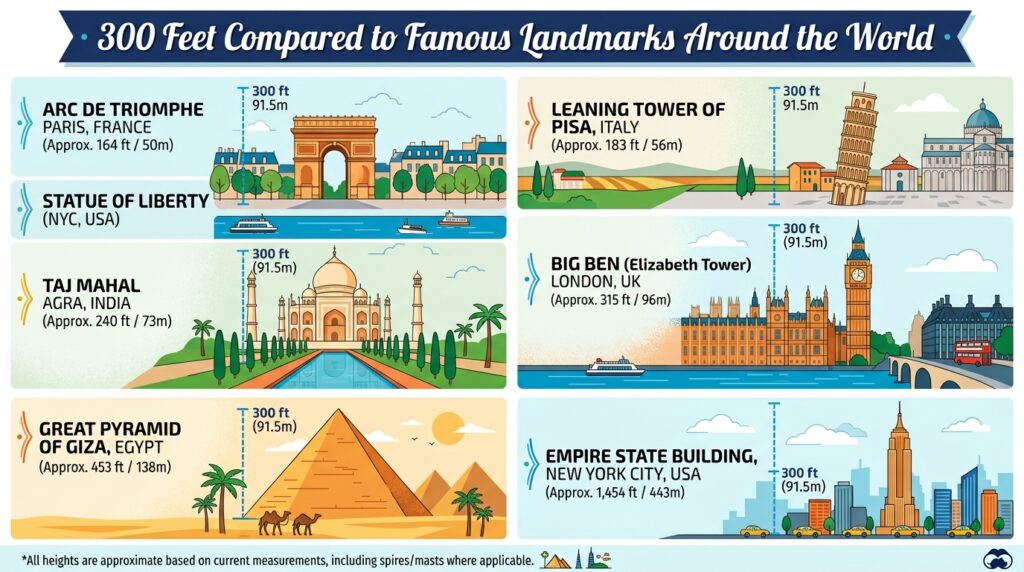
One of the best ways to understand how tall is 300 feet compared to buildings is by comparing it with landmarks people already recognize.
The Statue of Liberty: Almost Exactly 300 Feet Tall
The famous Statue of Liberty is one of the closest comparisons. The full height from the pedestal base to the torch peak is about 305.10 feet.
So when someone asks how tall is 300 feet, imagining the Statue of Liberty gives a surprisingly accurate answer. A 300-foot structure would stand almost shoulder-to-shoulder with this famous symbol of freedom.
The Statue of Liberty comparison is powerful because many people have seen photographs of the monument. They understand its scale even if they have never visited Liberty Island.
Big Ben: A Similar Height Experience
Big Ben is another useful comparison. The tower reaches around 310 feet high.
A structure that is 300 feet tall would look very similar in height to this famous London landmark. This helps answer questions like what objects are around 300 feet tall because a person can picture a recognizable clock tower instead of an abstract number.
The Leaning Tower of Pisa: Shorter Than 300 Feet
The Leaning Tower of Pisa reaches about 185 feet. Compared with 300 feet, it is much shorter.
A 300-foot structure would rise significantly higher than this Italian landmark. This comparison shows how quickly our understanding changes when we place measurements side by side.
Great Pyramid of Giza: Bigger Than 300 Feet
The Great Pyramid of Giza reaches about 430 feet in its original height. A 300-foot height comparison means the object would be impressive but still noticeably shorter than the pyramid.
Thinking about the ancient Construction of Great Pyramid helps people understand scale across history. Ancient builders created something much larger than many modern structures, which is pretty wild when you really think about it.
300 Feet Compared to Sports Fields
Sports provide some of the easiest ways to understand 300 feet comparison because field measurements are familiar to millions of people.
A standard soccer field, also called a football pitch in many countries, can vary in size. The football (soccer) pitch length is often around 344 feet. This means 300 feet is slightly shorter than the length of a typical soccer field.
Standing at one goal line and walking almost all the way to the opposite side gives a person a strong feeling of 300 feet visualized. It is a distance athletes experience regularly.
An NFL field is another helpful example. The full length of an American Football Field (NFL), including both end zones, is 360 feet. A 300 feet distance would stretch from one end zone close to the other side but would fall short of the complete field.
For sports fans, yard lines create an excellent measurement comparison. Since 300 feet equals 100 yards, it matches the basic playing distance of football before adding end zones.
Even golf provides perspective. The famous Pebble Beach Golf Links 17th hole measures around 531 feet.
A 300 foot distance would be a little more than half that famous golf hole. Golfers like Jack Nicklaus have helped make golf distances part of sports conversations, and those numbers give fans another way to imagine space.
Natural Wonders That Help Explain 300 Feet
Nature also gives us amazing examples for understanding 300 feet in real life.
A giant sequoia tree in the Sierra Nevada can reach incredible heights. Some Giant Sequoia Tree specimens grow close to or above 250 feet. A 300-foot tree would be taller than many of these ancient giants.
Imagine standing at the base of a tree that reaches 300 feet into the sky. The branches would seem far away, and looking up would create a strong feeling of scale. Nature has a way of making measurements feel emotional.
A blue whale offers another interesting comparison. A single blue whale is not 300 feet long, but three blue whales placed nose-to-tail would be roughly in that range. This is a strange but memorable way to understand 300 feet length.
It sounds a little silly at first, but these unusual comparisons stick in our minds better than plain numbers do.
Aircraft and Objects That Reveal the Scale of 300 Feet
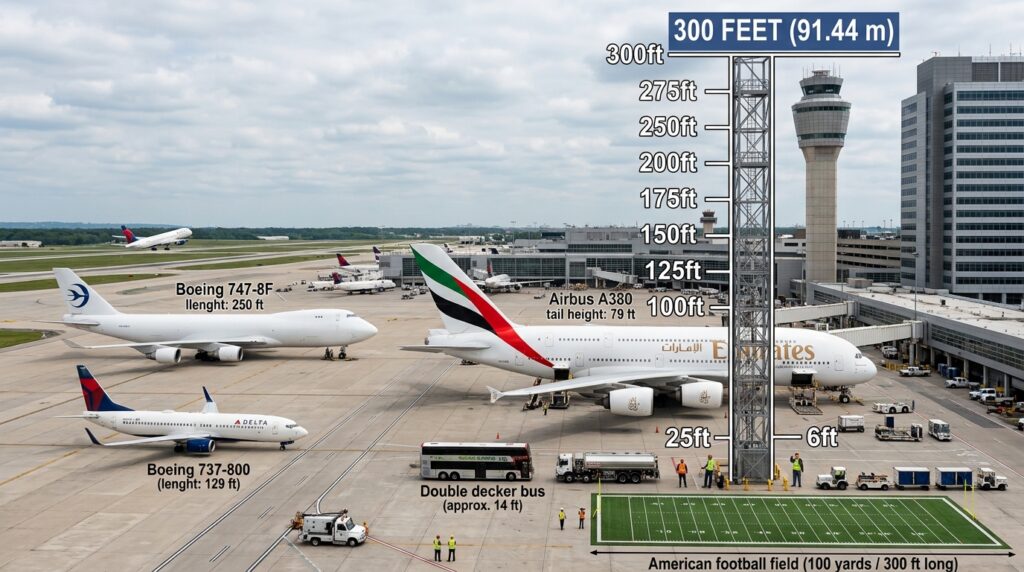
Large machines can also help answer how to visualize 300 feet distance.
The Boeing 747, often called the “Queen of the Skies,” has a wingspan of about 225 feet. A 300-foot distance would extend beyond the width of the aircraft.
Picture several airplanes lined up across an airport area. The scale becomes easier to feel because airplanes are already objects people recognize as massive.
Architecture uses similar thinking through architectural scaling and proportional design. Designers carefully consider how humans interact with large spaces.
A building that reaches 300 feet must account for elevators, windows, floors, safety systems, and how people experience the height from the ground.
Famous Structures Taller Than 300 Feet
Some landmarks show that 300 feet is impressive but not the limit of human construction.
Cinderella Castle is about 189 feet tall, meaning a 300-foot structure would be much taller.
The Spring Temple Buddha reaches around 502 feet, making it significantly taller than 300 feet. It demonstrates how cultures around the world have created giant monuments connected with faith, art, and devotion.
The Blackpool Tower provides another useful landmark comparison. It rises much higher than 300 feet, showing how towers can extend far beyond normal human scale structures.
The Mahabodhi Temple is around 180 feet high, while Nelson’s Column is approximately 169.40 feet. These examples show how varied landmark heights can be.
Why 300 Feet Feels Different Depending on Perspective
A fascinating part of measurement is that distance visualization is not only about numbers. It is about how the brain interprets distance.
A person looking at a skyscraper experiences forced perspective and sometimes an optical illusion. The building appears larger because the vertical distance stretches away from the viewer.
This is why a 300-foot tower can feel enormous, while a 300-foot walking path may feel ordinary.
Our memories also affect measurement. Someone walking 300 feet toward a loved one may experience that distance differently than someone walking 300 feet during a casual stroll. There is an emotional measurement happening too.
Numbers can describe physical space, but people fill that space with meaning. A distance can represent waiting, effort, excitement, or connection. That’s where measurement becomes part of human experience.
How to Remember What 300 Feet Looks Like
If you want to remember how long is 300 feet, keep these simple images in your mind:
- It is about the height of the Statue of Liberty.
- It equals 100 yards.
- It is slightly shorter than a soccer field.
- It is shorter than a full NFL field.
- It is longer than a Boeing 747 wingspan.
- It is close to the height of some famous towers.
These comparisons turn a plain number into a story. Instead of saying “300 feet,” you can imagine a landmark, a field, a walk, or a giant tree.
Frequently Asked Questions
300 feet visualized
Picture a distance of 300 feet (91.44 meters) as roughly the length of a football field without the end zones. It is much farther than most people expect.
300 feet comparison
A 300-foot distance is about 100 adult walking steps or the height of a 25–30 story building, making it easy to imagine in everyday life.
what is 300 feet long
Examples close to 300 feet include the length of a football field, a large passenger ferry, or three blue whales placed end to end.
what is 300 feet tall
A building around 25 to 30 stories tall is approximately 300 feet high. Many office towers and residential buildings fall within this range.
300 ft compared to human
An average person is about 6 feet tall, so 300 feet is equal to the height of about 50 adults standing one on top of another.
Read This Blog:https://hynoval.com/how-long-is-100-feet/
Final Thoughts: Making Sense of 300 Feet
So, how long is 300 feet? It is a distance that sits in a fascinating middle ground. It is not a tiny everyday measurement, but it is also not an impossible giant scale. It is large enough to impress us and familiar enough to understand.
Learning measurements through comparisons helps everyone, from students learning about length to travelers visiting famous structures. The next time you hear about a 300-foot building, bridge, or distance, you will have a mental picture waiting.
Measurements are more than numbers written on a page. They are stories about space, human creativity, nature, and the way we experience the world around us.
A simple number like 300 feet can connect a person standing on a sports field, an architect designing a tower, and someone looking up at a historic monument.
If you have a favorite way to visualize 300 feet, share it with others. Sometimes the strangest comparison is the one that helps someone finally understand the true scale.