

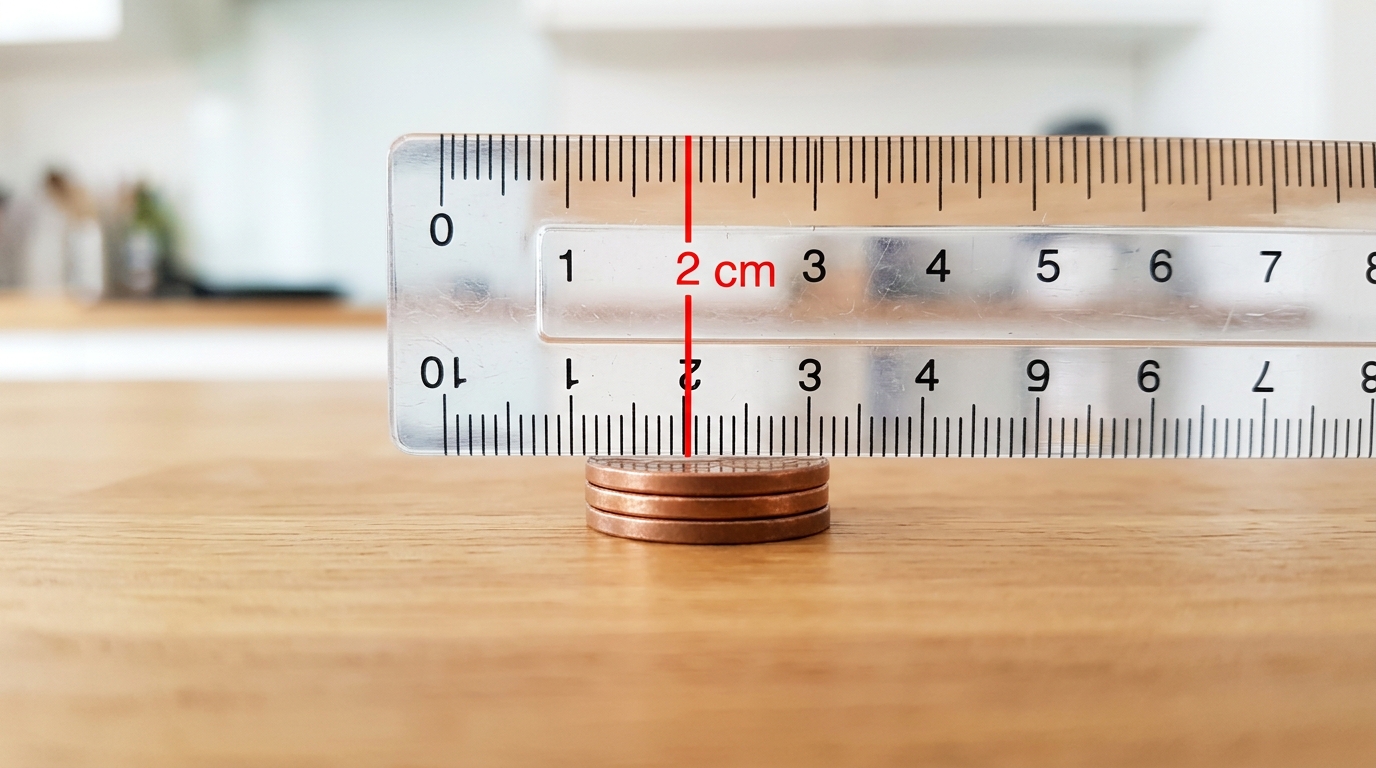
Have you ever looked at a measurement and thought, “Okay, but what does that actually look like in the real world?”
Numbers can feel strangely empty. 2 cm may appear tiny on paper, but when you hold a familiar object beside it, suddenly the measurement becomes alive.
A little button, a paperclip, or even a fingernail can turn an abstract number into something your brain instantly understands.
The question “How big is 2 cm?” is actually a beautiful little doorway into how humans understand space. We don’t naturally think in millimeters and centimeters while walking around our homes.
We think in objects, memories, and comparisons. A child understands the size of a toy piece before understanding a ruler, and adults often estimate dimensions by comparing them with things they already know.
It’s kinda amazing how our eyes become measuring tools without us even noticing.
In the metric system, 2 centimeters (2 cm) equals 20 millimeters, and it is approximately 0.79 inches. That means it is less than an inch but still large enough to notice.
Through these everyday object size comparisons, you can learn how to visualize centimeters, estimate lengths, and understand small measurements without carrying a ruler everywhere.
How Big Is 2 cm Compared to Everyday Objects
| Measurement | Equivalent |
|---|---|
| Length | 2 cm |
| Millimeters | 20 mm |
| Inches | 0.79 in |
| Common Comparison | About the width of an adult thumb |
| Small Object Example | Diameter of a bottle cap |
| Best Use | Estimating small everyday measurements |
Understanding 2 cm: Turning Numbers Into Real Life Size
A length measurement is simply a way of describing how long, wide, tall, or thick something is. But small measurements can be tricky because our brains are not always great at judging tiny distances.
A gap that looks “barely there” might actually be several millimeters, while something that seems larger could be only 2 centimeters.
When people ask “What does 2 centimeters look like?” they usually want a visual answer, not a mathematical one. They want to hold an object and say, “Ah, that’s about it.”
This is why a measurement reference is useful. Familiar objects become a bridge between numbers and reality.
A 2 cm size comparison can help in sewing, crafting, cooking, DIY projects, and even shopping online. Designers, engineers, and artists often work with tiny dimensions because a small change can completely alter the final product.
A few millimeters can decide whether a button fits, a connector locks, or a handmade piece looks balanced. Tiny things carry big consequences, kinda funny when you think about it.
1. A Small Paperclip: The Office Object That Reveals 2 cm
A common paperclip is one of the easiest ways to imagine this measurement. Many small paperclips have sections that come close to 2 cm, especially when looking at their shorter bends rather than their full stretched length.
The humble paperclip has a surprisingly interesting history. Samuel B. Fay was associated with an early paperclip patent, showing that even a tiny office item has a story behind it.
A small paperclip size comparison works because almost everyone has seen one. Put your finger beside the short end of a paperclip, and you can quickly understand the scale. It becomes a simple visual learning tool for children and adults alike.
- A small paperclip can represent a quick 2 cm measurement example.
- The curved wire shows how objects can have different lengths depending on where you measure.
- It helps explain why measuring from the correct starting point matters.
- It is useful for teaching kids about small-scale measurement.
- It turns a boring number into a physical object you can touch.
Sometimes the smallest office items are secretly little rulers sitting in a drawer, waiting for their moment.
2. Pencil Eraser: A Tiny Rectangle of Everyday Measurement
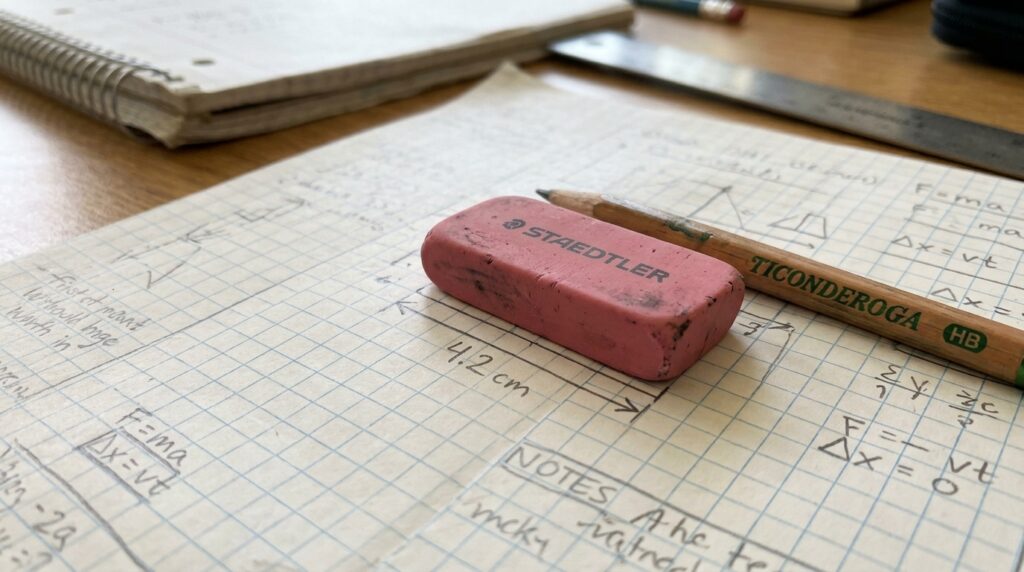
A standard pencil eraser is another familiar reference. Many pencil erasers have a width or height close to 2 cm, although the exact size changes between brands.
The history of erasers connects to scientific curiosity too. Joseph Priestley is often mentioned in discussions about early rubber erasers. It’s a reminder that even something used to remove mistakes has a surprisingly old background.
When you look at a pencil eraser, imagine slicing a little square from it. That small block gives your eyes a strong sense of what two centimeters looks like.
- A pencil eraser is a good real-life size comparison.
- Its width and thickness are easy to judge visually.
- It works well for classroom measurement education.
- It helps children understand physical dimensions.
- It provides a simple household measuring trick.
It’s kinda nice that something made for correcting mistakes can also teach us how to measure better.
3. Shirt Buttons and Coat Buttons: Fashion’s Hidden Measurements
Clothing contains many tiny measurements that people rarely notice. A shirt button, coat button, or jacket button can often have a diameter around 2 cm, especially medium-sized buttons.
Tailors work with these small details every day. A button that is slightly too large or too small can change the appearance and comfort of clothing. Sewing measurements depend heavily on precision because fabric, thread, and spacing all work together.
- A button diameter around 2 cm is common in many garments.
- Buttons provide useful centimeter comparison examples.
- They help beginners learn tailoring measurements.
- They are practical references during clothing repairs.
- They connect measurement with traditional craftsmanship.
Across places like India, Peru, and Sicily, traditional clothing makers have long relied on careful hand measurements.
Different communities developed their own methods, but the goal was always similar: creating something that fits the human body beautifully.
4. A Guitar Pick: Music Measured in Centimeters
A triangular guitar pick is another surprising way to visualize 2 cm. Many picks have widths that sit near this range, although guitar pick dimensions vary depending on thickness and style.
Musicians think about tiny differences constantly. A pick’s size, edge, and thickness can affect the sound and feeling of playing. These little musical accessories prove that small measurements can influence creativity.
- A guitar pick offers a clear 2 cm visual example.
- Its triangular shape makes spatial comparison easier.
- It shows how design uses small dimensions.
- It connects mathematics with music.
- It is an easy object to hold while estimating size.
A musician might never say, “My pick is a geometry lesson,” but honestly, it kinda is.
5. A U.S. Nickel: Comparing 2 cm With Coins
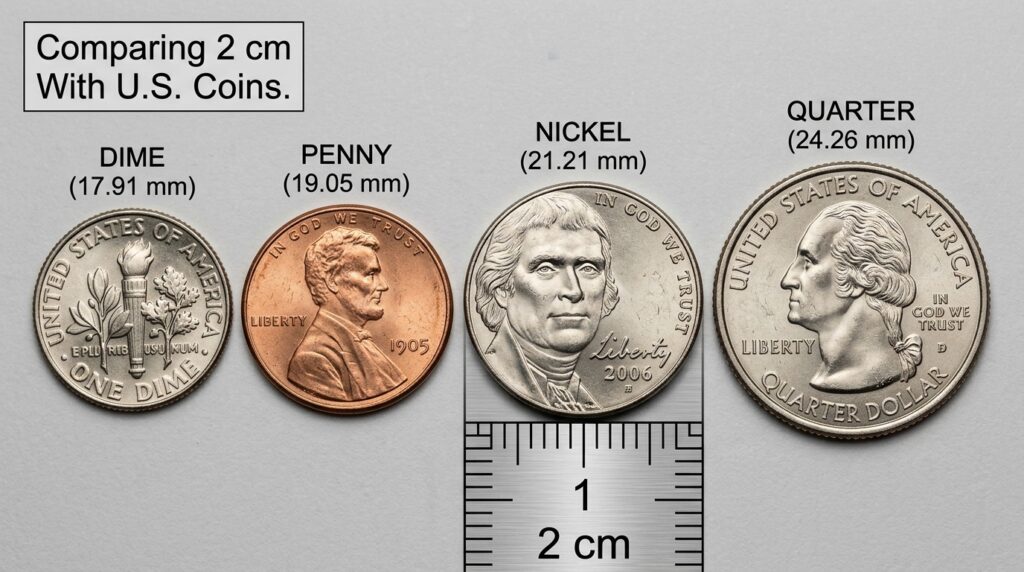
Coins are excellent measurement references because they are standardized. A U.S. Mint five-cent coin, commonly called a nickel, has a diameter of about 21.21 millimeters, which is extremely close to 2 cm.
This makes a nickel one of the best answers to “How big is 2 cm compared to a coin?”
- A nickel is slightly larger than 20 millimeters.
- It provides a reliable pocket measurement reference.
- It helps people visualize a 2 cm circle diameter.
- It works well for teaching geometry.
- It creates an easy everyday comparison.
Coins have helped humans understand value and size for centuries. A tiny piece of metal in your pocket can quietly explain mathematics.
6. Matchstick Head: A Tiny Object With a Big Measurement Story
A matchstick gives another interesting perspective. The whole stick is much longer than 2 cm, but the matchstick head itself is a tiny measurement reference.
Safety matches have an important history connected with inventors like Gustaf Erik Pasch. The development of safer matches changed everyday life, even though the final product looks simple.
- The matchstick head helps compare tiny widths.
- It demonstrates small measurement examples.
- It connects chemistry, design, and everyday objects.
- It shows how tiny spaces matter in manufacturing.
- It supports visual estimation skills.
Small objects often hide complex science behind them, which is pretty cool.
7. USB Drive Width: Technology’s Tiny Side
A USB stick or flash drive may be longer than 2 cm, but many parts of a storage device, such as the width of certain connectors or smaller tech components, can be close to this measurement.
Modern tech accessories rely heavily on precision. A tiny mistake in a connector design can stop a device from working correctly.
- USB drive width can help imagine small dimensions.
- It connects measurement with technology.
- It shows why precision engineering matters.
- It helps explain technical measurements.
- It makes abstract numbers feel practical.
Technology feels enormous, but it is built from incredibly small pieces.
8. Other Surprising Things Around 2 cm
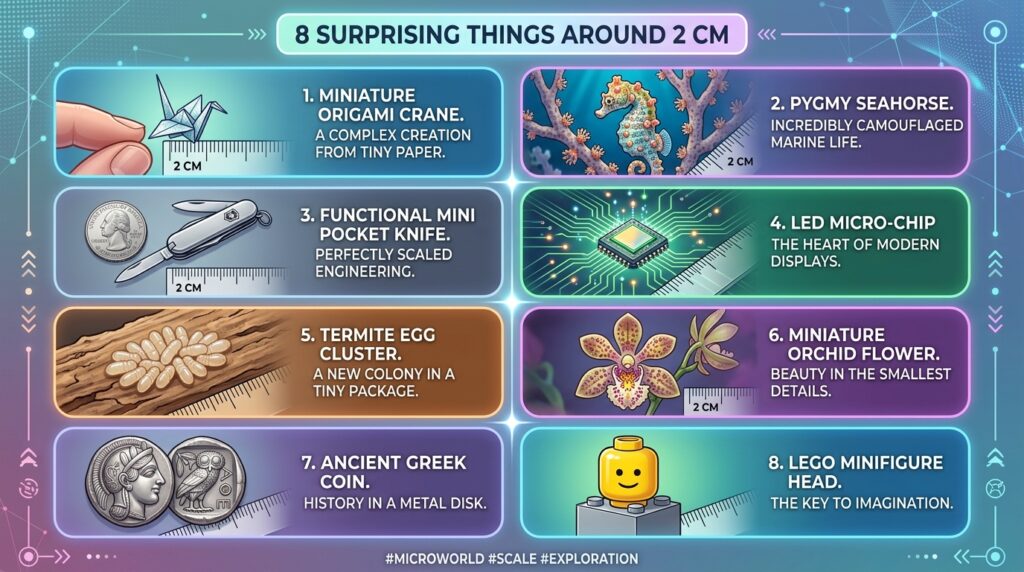
Many objects around you can help answer “What object is exactly 2 cm long?” The answer depends on the object and how it is measured, but many everyday items come close.
Examples include:
- A needle eye or small sewing detail.
- Certain beads used in jewelry making.
- A section of a domino piece.
- The width of some laptop keys.
- A small part of a pen clip.
- Some rice grains placed together.
- A thumb nail on some people.
These are not always exact measurements, but they are excellent approximate measurement tools. Real-world measurement is often about estimation first and precision second.
Measuring 2 cm Without a Ruler: Simple Tricks
Many people wonder, “How long is 2 cm without a ruler?” You can estimate it using your body and common objects.
A fingernail, especially a thumbnail, can sometimes provide a rough comparison. A finger joint segment can also help with body-based measurement methods, although everyone’s hands are different.
Useful methods include:
- Comparing with a coin.
- Using a known button size.
- Estimating with your thumbnail.
- Folding paper carefully.
- Using familiar household objects.
These methods are not perfect for measurement accuracy, but they are useful for quick decisions. For sewing, construction, medical measurements, or technical work, a proper tool is always better.
Why Understanding Small Measurements Matters
Learning how to visualize 2 cm size is more than a random trick. It improves spatial awareness and everyday mathematics. Children learn faster when they can touch and compare objects instead of only memorizing numbers.
Teachers often use hands-on activities because visual learning creates stronger memories. A classroom activity where students compare buttons, coins, paperclips, and blocks can make measurement feel less like homework and more like discovery.
Small measurements appear everywhere:
- Sewing measurements determine clothing fit.
- DIY measurements affect home projects.
- Jewelry making depends on tiny spacing.
- Cooking measurements sometimes require small adjustments.
- Product designers use exact dimensions daily.
A world built with no small measurements would be a very strange place.
Frequently Asked Questions
2 cm visual
A 2 cm visual is about the width of a standard peanut or the diameter of a small coin, making it easy to estimate by sight.
how much is two centimeters
Two centimeters equals 20 millimeters or approximately 0.79 inches. It is a short length commonly used for small objects.
how long is two cm
Two cm is a small measurement, roughly the width of an adult thumb or the diameter of a bottle cap, depending on the item.
Read this Blog: https://hynoval.com/36-inches/
Final Thoughts: Seeing Measurements Instead of Just Reading Them
Numbers become much more meaningful when they connect with everyday life. The next time someone asks
“How big is 2 cm?” you don’t need to imagine a lonely number floating on a page. Think of a nickel, a button, a pencil eraser, or a tiny piece of technology.
The beauty of length measurement is that it teaches us to notice the hidden details around us. Every object has a story of size, shape, and purpose.
A small measurement like 2 centimeters may seem ordinary, but it appears in design, art, clothing, technology, and countless daily moments.
Try creating your own 2 centimeter size comparison chart at home. Pick a few objects, compare them, and see how your understanding changes.
Share your favorite discovery with friends or family because sometimes the tiniest measurements create the biggest “oh wow” moments.